

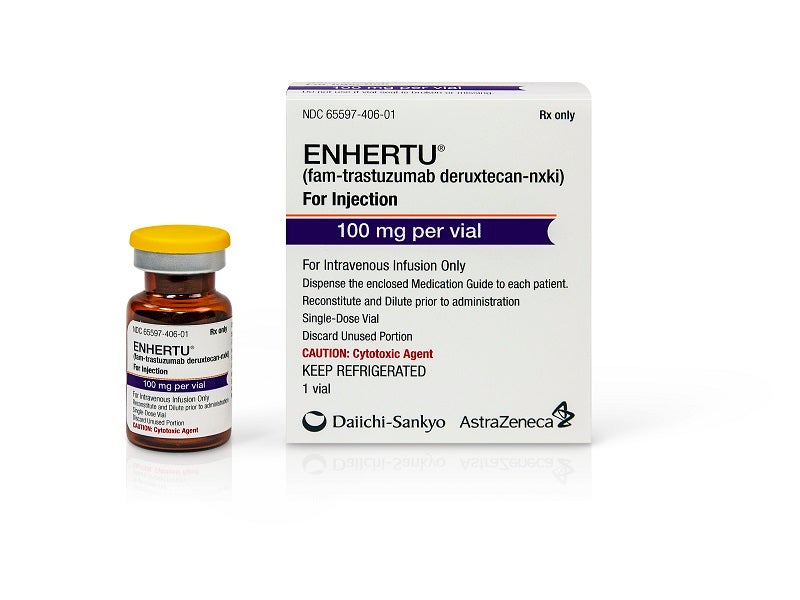
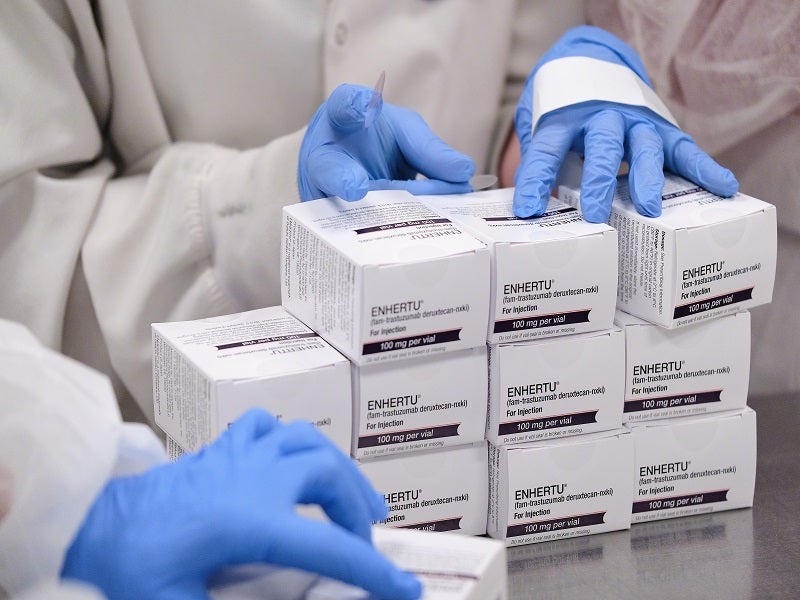
Enhertu® (fam-trastuzumab deruxtecan-nxki) is an antibody-drug conjugate indicated for the treatment of various types of cancer including gastric, breast and non-small cell lung cancer (NSCLC), as well as solid tumours.
Daiichi Sankyo and AstraZeneca entered into a strategic collaboration in March 2019 for the co-development and co-promotion of Enhertu.
Recommended Buyers Guides

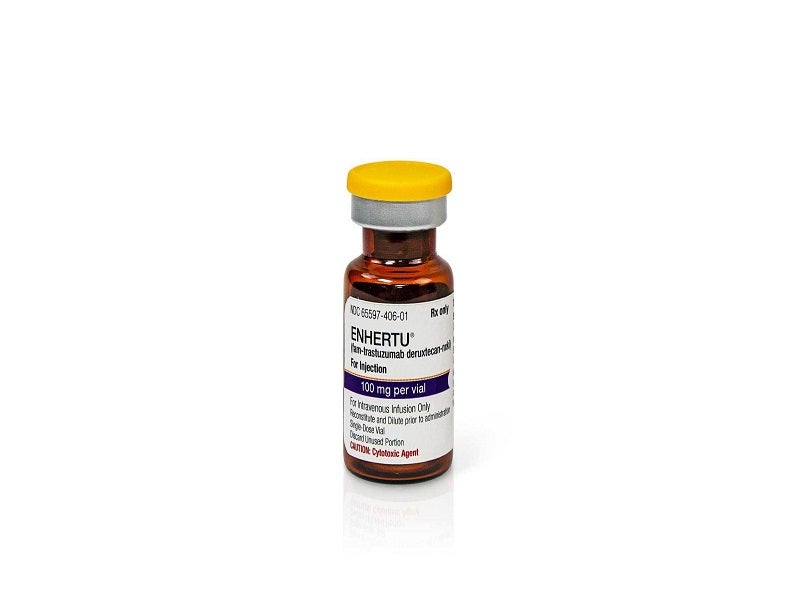
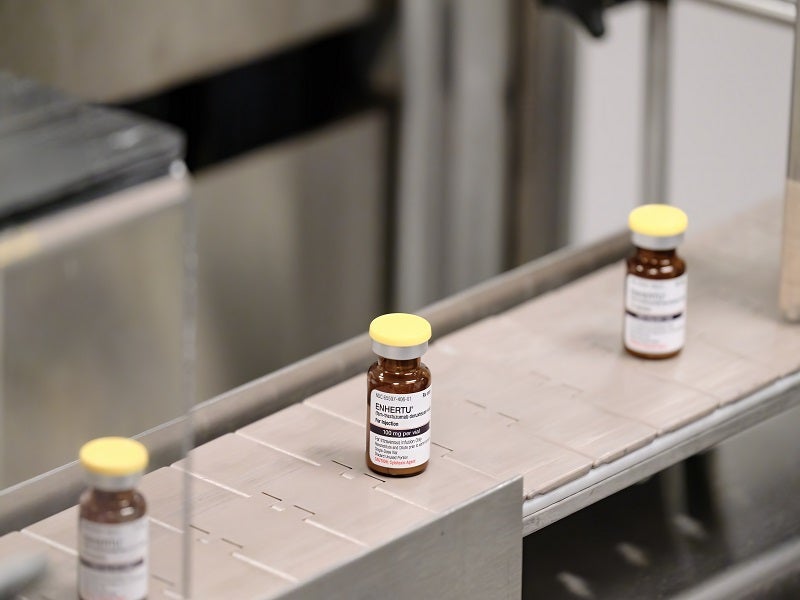
Enhertu is available as a 100mg sterile, white to yellowish-white lyophilised powder in a single-dose vial.
Regulatory approvals for Enhertu
Enhertu was first approved by the US Food and Drug Administration (FDA) in December 2019 for the treatment of patients with unresectable or metastatic HER2‑positive breast cancer who have previously received an anti‑HER2 regimen. It holds FDA breakthrough therapy designation from the FDA for this indication.
The drug is approved in more than 75 countries for adults with unresectable or metastatic hormone receptor (HR)-positive, HER2-low (IHC 1+ or IHC 2+/ISH−) or HER2-ultralow (IHC 0 with membrane staining) breast cancer, whose disease has progressed after at least one endocrine therapy in the metastatic setting.
Enhertu is also authorised in more than 100 countries worldwide for adults with unresectable or metastatic HER2-positive (IHC 3+ or ISH+) breast cancer previously treated with an anti‑HER2 regimen (in the metastatic or neo/adjuvant settings) and who experience recurrence during treatment or within six months of completing it.
Additionally, the drug is approved in more than 100 countries for adults with unresectable or metastatic HER2-low (IHC 1+ or IHC 2+/ISH) breast cancer who have received prior systemic therapy for metastatic disease, or who relapse during or within six months of finishing adjuvant chemotherapy.
For non-small cell lung cancer, Enhertu is authorised in more than 80 countries for adults with unresectable or metastatic disease whose tumours harbour activating HER2 (ERBB2) mutations and who have had previous systemic therapy.
Enhertu is approved in more than 90 countries for adults with locally advanced or metastatic HER2-positive (IHC 3+ or IHC 2+/ISH+) gastric or gastro-oesophageal junction adenocarcinoma after a trastuzumab-based regimen.
The drug is also approved across more than 45 countries for adults with unresectable or metastatic HER2-positive (IHC 3+) solid tumours previously treated with systemic therapy and lacking satisfactory alternative options.
Enhertu followed by taxane, trastuzumab, and pertuzumab is authorised in the US, China, Singapore and India for neoadjuvant use in adults with HER2-positive (IHC 3+ or ISH+) Stage II–III breast cancer.
The drug is authorised in Brazil and the US as adjuvant therapy for adults with HER2-positive (IHC 3+ or ISH+) breast cancer who have residual invasive disease after trastuzumab (with or without pertuzumab) and taxane-based therapy.
Enhertu plus pertuzumab has been approved in more than ten countries for first-line treatment of adults with unresectable or metastatic HER2-positive (IHC 3+ or ISH+) breast cancer.
Gastric cancer causes and symptoms
Gastric cancer, also known as stomach cancer, is the fifth most prevalent cancer in the world and the third leading cause of cancer mortality, with a five-year survival rate of 5% for metastatic disease. The disorder is often not diagnosed until it progresses to advanced stages, and its survival rate remains modest even for early diagnosis of the disease.
Symptoms of the disease include indigestion or stomach discomfort, bloody stools, weight loss, jaundice, stomach pain, a bloated feeling after eating, ascites [build-up of fluid in the abdominal cavity], vomiting, diarrhoea, heartburn and appetite loss.
Breast cancer causes and symptoms
Breast cancer is the second most frequently diagnosed cancer globally and remains a leading cause of cancer-related death. The most prevalent subtype is HR-positive and HER2-negative, accounting for 70% of breast cancers.
Symptoms include a change in the size or contour of one or both breasts, nipple discharge, a lump or swelling in either armpit and changes in a nipple’s appearance.
Non-small cell lung cancer causes and symptoms
NSCLC is a type of cancer that forms in the tissues of the lung. There are several types of non-small cell lung cancer, including squamous cell carcinoma, large cell carcinoma and adenocarcinoma.
Smoking is the leading cause of NSCLC, apart from a family history of lung cancer and secondhand smoke.
Symptoms of NSCLC include coughing, shortness of breath, chest pain and coughing up blood.
Enhertu mechanism of action
Fam-trastuzumab deruxtecan-nxki is a HER2-directed antibody-drug conjugate composed of an IgG1 humanised anti-HER2 antibody.
The drug’s small molecule is DXd, an inhibitor of topoisomerase I. This binds to the HER2 antibody found on tumour cells via a cleavable linker, after which fam-trastuzumab deruxtecan-nxki undergoes internalisation and intracellular linker cleavage by lysosomal enzymes.
DXd permeable membrane causes DNA damage and apoptotic cell death after it is released through cleavage.
Clinical trials of Enhertu for the treatment of GEJ adenocarcinoma
The FDA’s approval of Enhertu for the treatment of patients with locally advanced or metastatic HER2-positive gastric or GEJ adenocarcinoma was based on the outcome of a randomised, open-label, multicentre, pivotal phase two trial, DESTINY-Gastric01.
The drug’s safety and efficacy were evaluated in 188 patients from Japan and South Korea with locally advanced or metastatic HER2-positive gastric or GEJ adenocarcinoma, who had progressed to at least two previous regimens including trastuzumab, fluoropyrimidine or platinum-containing chemotherapy.
Patients were randomised at a 2:1 ratio to receive Enhertu 6.4mg/kg intravenously every three weeks or a physician’s choice of chemotherapy – either irinotecan or paclitaxel monotherapy.
The trial’s primary efficacy outcome measures were overall survival (OS) and objective response rate (ORR) as assessed by the independent central review (RECIST v1.1) in the intent-to-treat population. Additional efficacy outcome measures included progression-free survival (PFS) and duration of response (DOR).
The OS reached a median of 12.5 months in the Enhertu arm compared with 8.4 months in the irinotecan or paclitaxel arm, while the ORR of the Enhertu arm was 40.5% compared with 11.3% in the chemotherapy segment.
Enhertu also demonstrated a median PFS of 5.6 months versus 3.5 months for chemotherapy. The median DOR was 11.3 months in the Enhertu arm, compared with 3.9 months in the irinotecan or paclitaxel arm.
Other clinical trials for this indication include DESTINY-Gastric02, DESTINY-Gastric03, DESTINY-Gastric04, DESTINY-Gastric05 and DESTINY-Gastric06.
The drug is being evaluated further under a comprehensive clinical development programme that will assess its efficacy and safety across several HER2-targetable cancers.
Other clinical trials on Enhertu
The FDA approval of Enhertu for the treatment of patients with metastatic HER2-positive solid tumours was based on the DESTINY-PanTumor02 and DESTINY-CRC02 trials.
DESTINY-PanTumor02 enrolled 347 patients and demonstrated an ORR of 51.4% for patients with HER2-positive solid tumours.
In the DESTINY-CRC02 trial, patients with centrally confirmed HER2-positive colorectal cancer showed a confirmed ORR of 46.9% and a median DOR range of 5.5 months.
Other clinical trials for this indication include DESTINY-CRC01, DESTINY PanTumor02 and DESTINY PanTumor03.
Enhertu was evaluated for the treatment of NSCLC in the DESTINY-Lung01, DESTINY-Lung02, DESTINY-Lung03, DESTINY-Lung04, DESTINY-Lung05 and DESTINY-Lung06.
In DESTINY-Lung01, patients with HER2-positive NSCLC showed a confirmed ORR of 52.9% and a median DOR range of 6.9 months.
In August 2026, the ongoing DESTINY-Lung04 trial has shown a significant improvement in PFS compared with the current global standard of care – platinum–pemetrexed doublet chemotherapy plus pembrolizumab – as a first-line treatment for patients with unresectable, locally advanced or metastatic HER2-mutant NSCLC.
The evaluation of Enhertu for the treatment of unresectable or metastatic HER2-positive breast cancer involved the DESTINY-Breast01, DESTINY-Breast02, DESTINY-Breast03 and DESTINY-Breast04 studies.
It is currently being evaluated further for this indication in the DESTINY-Breast05, DESTINY-Breast06, DESTINY-Breast07, DESTINY-Breast08, DESTINY-Breast09 and DESTINY-Breast12 trials.
