

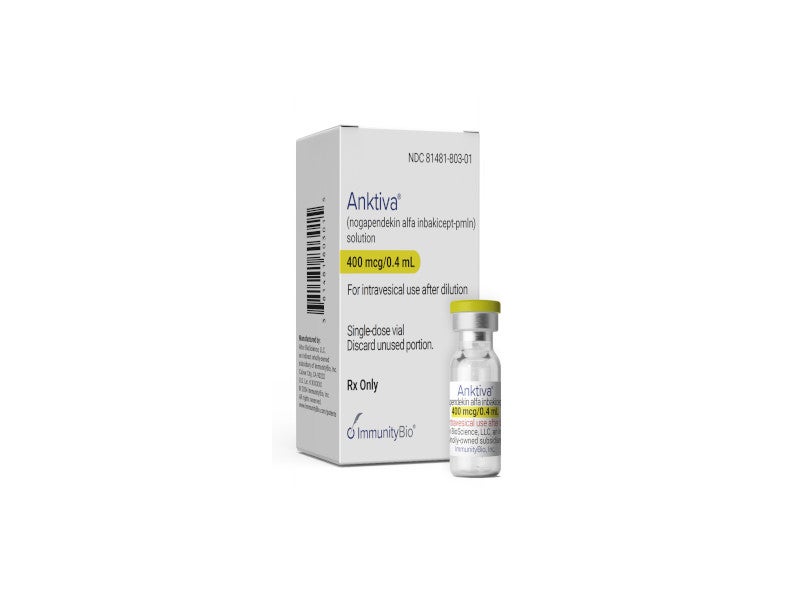
ANKTIVA® (nogapendekin alfa inbakicept), in combination with bacillus Calmette-Guerin (BCG), is indicated for adult patients with BCG-unresponsive non-muscle invasive bladder cancer (NMIBC), including carcinoma in situ (CIS), with or without papillary tumours.
Developed by US-based biotechnology company ImmunityBio, ANKTIVA is the first-in-class interleukin-15 (IL-15) receptor agonist targeting BCG-unresponsive NMIBC. The drug is currently approved in 34 countries.
Recommended Buyers Guides

In May 2024, ImmunityBio signed an exclusive worldwide deal with the pharmaceutical company Serum Institute of India for the large-scale production of BCG for use alongside ANKTIVA.
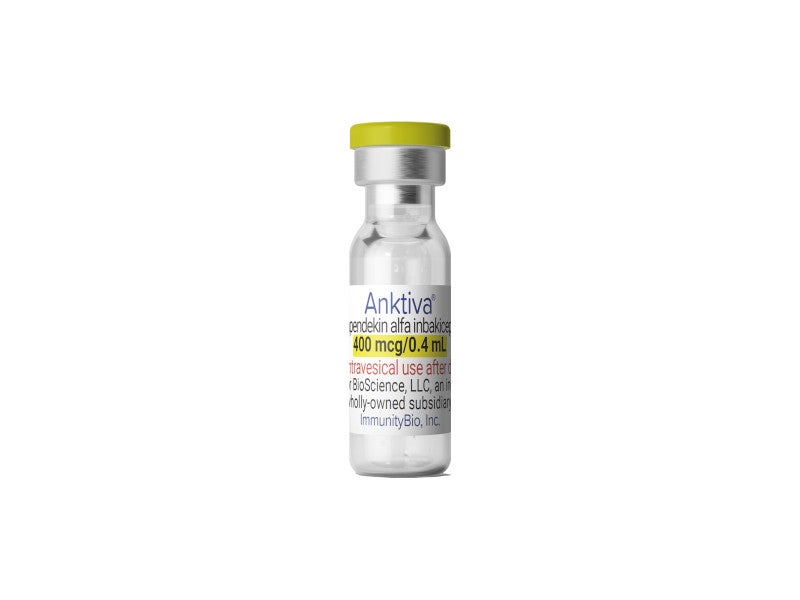
ANKTIVA is administered as a clear-to-slightly opalescent, colourless-to-slightly-yellow solution in a 400-microgram (mcg)/0.4ml strength, provided in single-dose vials for intravesical instillation after dilution.
Regulatory approvals
The US Food and Drug Administration (FDA) approved ANKTIVA in April 2024.
The UK Medicines and Healthcare products Regulatory Agency granted marketing authorisation for ANKTIVA in July 2025.
In January 2026, the drug received accelerated approval from the Saudi Food and Drug Authority to be used alongside immune checkpoint inhibitors (CPIs) in adult patients with metastatic non-small cell lung cancer (NSCLC) whose disease had worsened following standard-of-care treatment. The drug became commercially available in Saudi Arabia two months after the approval.
The European Commission granted conditional marketing authorisation for the drug in February 2026 for the treatment of adult patients with BCG-unresponsive NMIBC, including CIS, with or without papillary tumours.
The drug received regulatory approval from the Pharmaceutical Administration Bureau of the Macau Special Administrative Region of the People’s Republic of China in March 2026 for the treatment of adult patients with BCG-unresponsive NMIBC.
In May 2026, ImmunityBio received US FDA acceptance for the supplemental Biologics License Application for ANKTIVA in combination with BCG for the treatment of patients with BCG-unresponsive NMIBC with papillary disease without CIS. The FDA has set a Prescription Drug User Fee Act target action date of 6 January 2027.
Bladder cancer causes and symptoms
Bladder cancer originates in the urothelial cells lining the bladder and can also affect the kidneys and ureters. Symptoms such as blood in the urine (haematuria), frequent urination, painful urination and back pain can signal the presence of the disease. While early-stage bladder cancers are highly treatable, the risk of recurrence necessitates long-term follow-up tests.
Globally, bladder cancer ranks as the tenth most diagnosed cancer. The American Cancer Society estimates that the US alone will witness 83,190 new cases and 16,840 deaths due to bladder cancer in 2024.
The typical treatment for NMIBC involves delivering BCG directly into the bladder through a catheter. BCG, a harmless bacterium, triggers an immune reaction in the bladder near the cancerous cells, often resulting in the eradication of the cancer. However, BCG proves ineffective in around 30–40% of cases, and approximately 50% of those who initially respond will experience a recurrence.
ANKTIVA’s mechanism of action
The cytokine IL-15 is pivotal in the immune system, influencing the development, upkeep and functionality of crucial immune cells such as NK and CD8+ killer T cells, which play a role in eliminating cancer cells.
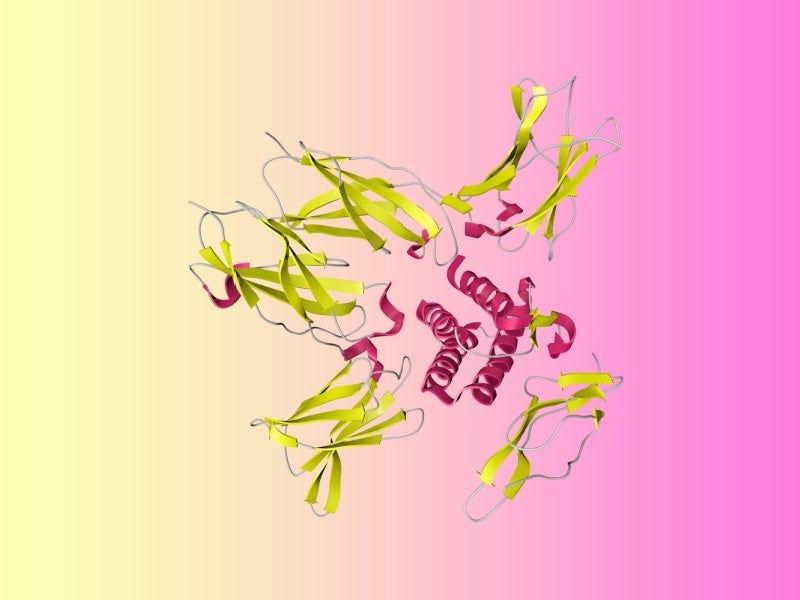
ANKTIVA represents a new IL-15 super agonist complex featuring an IL-15 mutant (IL-15N72D) fused with an IL-15 receptor alpha. The complex binds strongly to IL-15 receptors on NK, CD4 and CD8 T cells, akin to the natural actions of dendritic cells.
The drug enables a targeted attack on tumour cells by activating the body’s natural killer and killer T-cell immune system.
Subsequently, the activation and proliferation of these cytotoxic cells result in a sustained complete response. ANKTIVA features enhanced pharmacokinetic characteristics, prolonged presence in lymphoid tissues and heightened anti-tumour efficacy in comparison to native, uncomplexed IL-15 in vivo.
ANKTIVA is an advanced immunotherapy beyond CPIs, serving as an alternative to radical cystectomy, a surgical procedure for patients having limited options after the failure of BCG.
Clinical trials on ANKTIVA
The FDA’s approval of ANKTIVA is based on the safety and efficacy data from the single-arm, multi-centre, Phase II/III QUILT 3.032 clinical trial.
A total of 77 evaluable patients with high-risk, BCG-unresponsive NMIBC with CIS, with or without Ta/T1 papillary disease, following transurethral resection, received ANKTIVA with BCG maintenance therapy for up to 37 months.
Tumour status was rigorously assessed through cystoscopy and urine cytology every three months for two years, and mandatory biopsy within six months of treatment initiation.
The primary efficacy measures were the complete response (CR) rate and the duration of complete response (DOR). The trial reported a CR rate of 62% for the evaluable patients.
The DOR was more than 47 months, as of November 2023. The extended period of response, surpassing 47 months, is a significant breakthrough for NMIBC patients. It offers additional clinical proof of ANKTIVA’s effectiveness for patients who typically experience frequent recurrence and a considerable decline in their quality of life due to radical surgeries.
Among patients who achieved CR, 58% had a response lasting at least 12 months and 40% had a response lasting at least 24 months.
Recent findings from Cohort A (n=100) of the QUILT-3.032 trial indicate that treatment with ANKTIVA in combination with BCG achieved a complete response rate of 71% in patients with BCG-unresponsive NMIBC with CIS, with or without papillary tumours. Response durations extended beyond 53 months and 60% of complete responses lasted for at least 12 months.
For the FDA label population within Cohort A (N=77), which has a longer median follow-up of 29.3 months, data showed a 51% probability that complete responses would be maintained for at least 45 months. Among responders, 84.2% had avoided cystectomy at 36 months, and disease-specific overall survival at 36 months was 99%.
In Cohort B (n=80), which enrolled patients with BCG-unresponsive NMIBC papillary disease without CIS, ANKTIVA plus BCG produced a 12‑month disease-free survival (DFS) rate of 58.2%, meeting the primary endpoint. Median DFS was 25.3 months. At 36 months, 82% of patients had not undergone cystectomy and disease-specific overall survival was 96%.
The most common adverse reactions observed were increased creatinine, dysuria, haematuria, urinary frequency and micturition urgency, in addition to urinary tract infection, increased potassium, musculoskeletal pain, chills and pyrexia.
Additional studies
The safety and efficacy of ANKTIVA in NSCLC were evaluated in two multi-cohort, open-label studies, QUILT-2.023 and QUILT-3.055.
QUILT-2.023 (NCT03520686) is a Phase III trial comprising three randomised cohorts and one exploratory cohort, each assessed independently. The primary randomised cohort enrolled patients with stage III or IV squamous or non-squamous NSCLC, PD-L1 expression of at least 1% and no prior systemic therapy for advanced disease.
Participants were randomised 1:1 to receive either a CPI alone or CPI in combination with ANKTIVA. The primary endpoint was progression-free survival, evaluated using RECIST v1.1, with serial absolute lymphocyte count prospectively included as a key biological endpoint.
QUILT-3.055 (NCT03228667) is a Phase IIb, multi-cohort, open-label study investigating the addition of ANKTIVA to ongoing PD-1/PD-L1 inhibitor therapy in patients with advanced solid tumours who experienced disease progression following prior checkpoint inhibition. The study enrolled heavily pretreated patients, including those with second and later-line NSCLC.
Patients remained on the same CPI to which they had previously achieved response or disease stabilisation, while ANKTIVA was administered subcutaneously in repeated six-week cycles.
The primary objective was to prospectively relate immune parameters to clinical outcomes by assessing overall survival in relation to absolute lymphocyte count response, defined as achieving or maintaining a mean on-treatment ALC of at least 1,000 cells/microlitre. Secondary endpoints included objective response rate, progression-free survival, duration of therapy and safety.
Across 151 patients treated in first, second and later-line settings, ANKTIVA demonstrated statistically significant immune restoration, with a consistent association observed between lymphocyte recovery and improved survival in patients previously treated with immune CPIs.
