

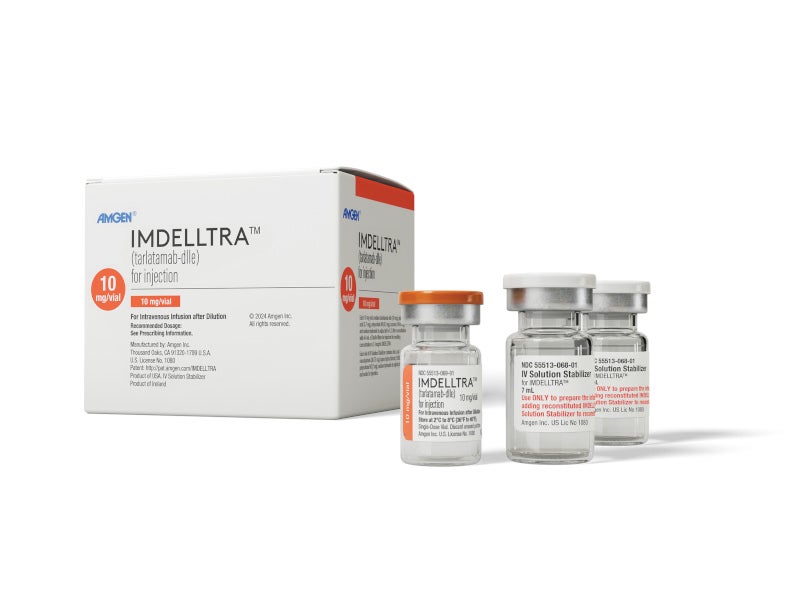


IMDELLTRA™ (tarlatamab) is a first-in-class immunotherapy indicated for the treatment of extensive-stage small cell lung cancer (ES-SCLC) in adult patients who have experienced disease progression on or after platinum-based chemotherapy.
Developed by Amgen, a biotechnology company based in the US, it is the first and only delta-like ligand 3 (DLL3)-targeting the bispecific T-cell engager (BiTE®) molecule designed to activate the patient’s own T cells to target and attack DLL3-expressing tumour cells.
Recommended Buyers Guides

The US Food and Drug Administration (FDA) granted accelerated approval to IMDELLTRA in May 2024, following the promising response rate and duration of response (DoR) observed in the Phase II DeLLphi-301 clinical trial.
The FDA granted full approval to IMDELLTRA in November 2025 based on the results of the Phase III DeLLphi-304 study.
In January 2025, the UK Medicines and Healthcare products Regulatory Agency granted the drug a conditional marketing authorisation based on results from the Phase II DeLLphi-301 study. The drug is marketed as IMDYLLTRA® in the UK.
IMDELLTRA is available for intravenous administration in 1mg and 10mg strength doses, supplied as a lyophilised powder in a single-dose vial for reconstitution and further dilution.
ES-SCLC causes and symptoms
Small cell lung cancer (SCLC) is a rare but aggressive form of lung cancer, with extensive-stage disease signifying a more advanced spread. Typically linked to tobacco use, SCLC can metastasise to various parts of the body including lymph nodes and organs such as the brain and liver.
The disease is classified into two main types; small cell carcinoma and combined small cell carcinoma, which together represent 2% to 5% of all lung cancers.
Risk factors for SCLC extend beyond smoking to include second-hand smoke exposure, previous radiation therapy for other cancers, radon gas exposure, occupational hazards, a family history of lung cancer and HIV infection.
Symptoms of SCLC are often not apparent until the disease has progressed, but can include chest pain, persistent coughing (sometimes with blood), shortness of breath, facial swelling, fatigue, hoarseness, loss of appetite, swollen neck veins, weight loss and wheezing.
IMDELLTRA’s mechanism of action
The BiTE molecule tarlatamab is engineered to bind to DLL3, expressed on the surface of tumour cells, and CD3, expressed on the surface of T-cells, simultaneously.
The dual binding activates T-cells to release inflammatory cytokines and induces lysis of DLL3-expressing cells, exhibiting significant anti-tumour activity.
BiTE technology
Amgen’s BiTE technology is an innovative immuno-oncology platform designed to harness a patient’s T cells to target and destroy cancer cells by recognising specific tumour antigens. The approach has the potential to treat various tumour types and aims to provide off-the-shelf solutions, making advanced T-cell treatments accessible to healthcare providers for timely patient care.
IMDELLTRA is the company’s second FDA-approved BiTE molecule following BLINCYTO® (blinatumomab), a bispecific CD19-directed CD3 T-cell engager indicated for B-cell precursor acute lymphoblastic leukaemia.
Amgen is currently exploring more than a dozen BiTE molecules for their application across a wide spectrum of haematologic malignancies and solid tumours.
Clinical trials on IMDELLTRA
The Phase II DeLLphi-301 clinical trial assessed the efficacy of the drug in patients with relapsed or refractory (r/r) ES-SCLC after two or more previous treatment lines.
The open-label, multi-centre, multi-cohort clinical trial involved 99 patients who received IMDELLTRA intravenously, starting with an initial dose of 1mg on cycle one, day one, followed by 10mg on days eight and 15, and then every two weeks until either disease progression or unacceptable toxicity occurred.
Patients with symptomatic brain metastases, interstitial lung disease, non-infectious pneumonitis or active immunodeficiency were excluded from the trial.
IMDELLTRA demonstrated an impressive 40% objective response rate, a median DoR of 9.7 months and a median overall survival (OS) of 14.3 months in the pivotal study.
The most common adverse reactions reported during the clinical trial included cytokine release syndrome, fatigue, fever, dysgeusia (altered taste) and reduced appetite.
Additional clinical trials on IMDELLTRA
Amgen is currently investigating tarlatamab in several clinical trials within its robust tarlatamab development programme, both as a monotherapy and in combination with other treatments in earlier stages of SCLC.
DeLLphi-303, a Phase Ib clinical trial, evaluated the safety and efficacy of tarlatamab in combination as a first-line treatment for ES-SCLC.
In this Phase Ib study, 88 patients with ES-SCLC who had completed four to six cycles of platinum–etoposide chemotherapy plus an anti–PD-L1 agent (when available) without experiencing disease progression were enrolled. Within eight weeks of starting their final chemo-immunotherapy cycle, maintenance therapy with tarlatamab was initiated, combined with either atezolizumab or durvalumab, continuing treatment until progression.
After a median follow-up of 18.4 months, median OS was 25.3 months, and median progression-free survival (PFS) was 5.6 months.
The FDA’s full approval was based on the DeLLphi-304 study, a randomised, open-label, Phase III trial, which evaluated the safety and effectiveness of tarlatamab in treating patients with ES‑SCLC whose disease progressed on or after one line of platinum-based chemotherapy.
A total of 509 patients were randomised in a 1:1 ratio to receive either tarlatamab or locally defined standard-of-care (SOC) chemotherapy.
The primary endpoint of the trial was OS, while the secondary endpoint was PFS and patient-reported outcomes.
The results of the trial indicated that tarlatamab reduced the risk of death by 40% and significantly increased median OS by more than five months compared with SOC chemotherapy in patients.
The study also showed a statistically significant improvement in dyspnoea at week 18 in the tarlatamab group versus SOC.
DeLLphi-305, a Phase III trial, is assessing tarlatamab in combination with durvalumab versus durvalumab alone in ES-SCLC patients, while another Phase III trial, DeLLphi-306, is evaluating tarlatamab following concurrent chemoradiotherapy in limited-stage SCLC.
Additional trials include DeLLphi‑308, a Phase Ib trial assessing subcutaneous tarlatamab in the second line and beyond; DeLLphi‑309, a Phase II study exploring alternative intravenous dosing schedules of tarlatamab in second-line ES‑SCLC; and DeLLphi‑310, a Phase Ib study investigating tarlatamab plus YL201, an innovative anti-B7-H3 antibody-drug conjugate, with or without an anti‑PD‑L1 agent, in ES‑SCLC patients.
DeLLphi‑311 is a Phase Ib trial evaluating IMDELLTRA combined with etakafusp alfa (AB248), a new CD8+ T‑cell–selective interleukin‑2 (IL‑2), in ES‑SCLC; and DeLLphi‑312 is a Phase III study testing tarlatamab as induction and maintenance therapy in the first-line setting alongside carboplatin, etoposide and durvalumab.
