

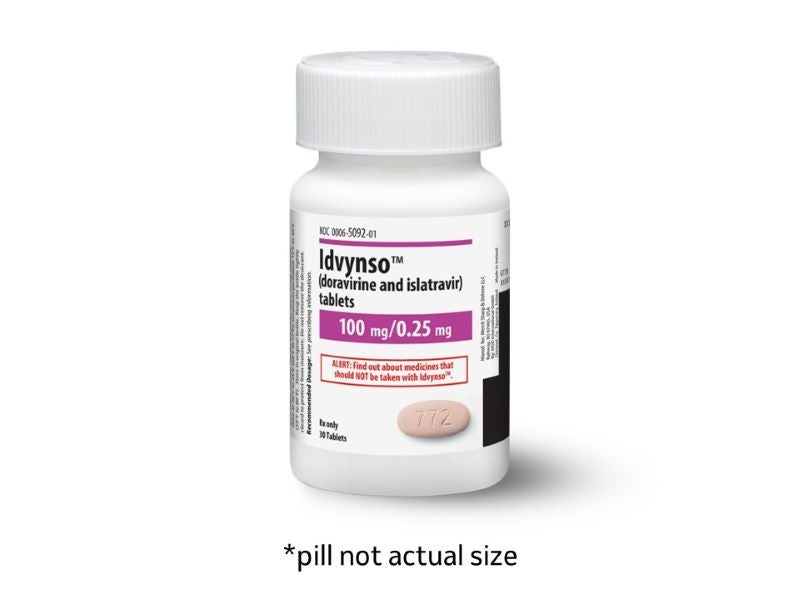

Idvynso™ (doravirine/islatravir) is a two‑drug, single‑tablet regimen containing doravirine and islatravir, authorised for the treatment of human immunodeficiency virus (HIV)‑1 infection in adults.
Developed by Merck & Co., the combination is indicated as a replacement for an existing antiretroviral regimen in virologically suppressed adults (HIV‑1 RNA below 50 copies/millilitre (ml)) who are on a stable antiretroviral regimen, have no history of virologic treatment failure and have no known substitutions associated with resistance to doravirine.
Recommended Buyers Guides

Idvynso received regulatory approval in Japan in March 2026 and was subsequently approved by the US Food and Drug Administration (FDA) the following month.
The drug is available as pink film-coated oval-shaped tablets, with each tablet containing 100mg of doravirine and 0.25mg of islatravir. The recommended dose for adults is one tablet taken orally once daily, with or without food.
Idvynso is contraindicated in combination with medicinal products that are strong inducers of cytochrome P450 (CYP)3A, as well as with lamivudine (3TC) or emtricitabine (FTC). Co‑administration with these agents may reduce the effectiveness of Idvynso.
HIV-1 causes and symptoms
HIV targets CD4 T lymphocytes in the body, and as their numbers fall, immunity declines. If left untreated, the infection may advance to AIDS (acquired immunodeficiency syndrome).
HIV is broadly classified into two forms, HIV-1 and HIV-2. While both variants spread through the same transmission pathways and are capable of leading to AIDS, they differ meaningfully in their geographic distribution, disease course, diagnostic considerations and clinical care.
HIV-1 accounts for most cases within the global AIDS pandemic and is associated with a highly aggressive disease course, while HIV-2 is generally associated with slower clinical progression and reduced likelihood of sexual or mother-to-child transmission.
There is no cure for either form of HIV, but antiretroviral therapy can suppress the virus and slow disease progression.
In acute HIV infection, some individuals develop flu‑like symptoms such as fever, headache, rash, sore throat and mouth ulcers, as well as swollen lymph nodes, diarrhoea, weight loss, cough and night sweats.
According to estimates from the Joint UN Programme on HIV/AIDS, approximately 40.8 million people worldwide are living with HIV.
Idvynso’s mechanism of action
Idvynso is a fixed‑dose combination comprising two antiretroviral agents: doravirine, a HIV‑1 pyridinone non‑nucleoside reverse transcriptase inhibitor (NNRTI), and islatravir, a deoxyadenosine nucleoside analogue reverse transcriptase inhibitor (NRTI).
Together, these antiretroviral agents act on HIV‑1 reverse transcriptase to help limit viral replication in the body.
Doravirine inhibits HIV‑1 replication through non‑competitive inhibition of the viral reverse transcriptase (RT) enzyme. It does not inhibit human cellular DNA polymerases alpha (α), beta (β) or mitochondrial DNA polymerase γ (poly γ).
Islatravir is phosphorylated by kinases to its active form, islatravir‑triphosphate, within cells. This active metabolite inhibits RT after incorporation into nascent viral DNA by blocking translocation, resulting in immediate chain termination. It induces conformational changes in the viral DNA that prevent further nucleotide incorporation, leading to delayed chain termination.
Clinical trials on Idvynso
The safety and efficacy of Idvynso in virologically suppressed adults living with HIV were evaluated using 48‑week data from two Phase III, randomised, active‑controlled, non‑inferiority studies: Trial 051 and Trial 052. Across both trials, 708 participants received once‑daily Idvynso.
Trial 051 was an open‑label study in which 551 participants were randomised in a 2:1 ratio. A total of 366 participants were switched from an oral antiretroviral therapy to Idvynso and 185 remained on their existing baseline antiretroviral therapy (bART).
Trial 052 was a double‑blind study involving 513 participants, also randomised 2:1. Of these, 342 participants switched from bictegravir/emtricitabine/tenofovir alafenamide (BIC/FTC/TAF) to Idvynso, while 171 continued with BIC/FTC/TAF.
In both clinical trials, the primary endpoint was the proportion of participants with HIV-1 RNA levels ≥50 copies/ml at week 48.
In Trial 051, 1% of participants who transitioned to Idvynso recorded viral loads ≥50 copies/ml, versus 5% among those who remained on bART. This equated to a treatment difference of -3.6%.
For the secondary endpoint at week 48, viral suppression (HIV-1 RNA <50 copies/ml) was maintained in 96% of patients who switched to Idvynso, compared to 92% of those continuing with bART.
In Trial 052, 1% of participants who were switched to Idvynso had HIV-1 RNA levels ≥50 copies/ml, versus 1% of those who remained on BIC/FTC/TAF, resulting in a treatment difference of 0.9%.
For the week 48 secondary endpoint, 92% of participants who transitioned to Idvynsosustained viral suppression, compared with 94% of participants who continued on BIC/FTC/TAF.
Among participants treated with Idvynso who reported at least one adverse event in either Trial 051 or Trial 052, 88% experienced only mild (Grade 1) or moderate (Grade 2) events. The most frequently reported adverse reactions (all grades), occurring in at least 2% of participants in any treatment arm through week 48 across both trials, were diarrhoea, dizziness, fatigue, abdominal distension, headache and increased weight.
