
Incannex Healthcare (Nasdaq: IXHL), a clinical‑stage pharmaceutical development company focused on developing novel therapies for conditions with limited effective treatment options, has won the Research and Development award in the Respiratory Disorders category of the 2025 Clinical Trials Arena Excellence Awards for its targeted development of IHL‑42X as a pharmacologic alternative for obstructive sleep apnea (OSA).
OSA is a chronic disorder still predominantly managed with device‑based therapies such as positive airway pressure. Incannex is developing IHL‑42X as an oral fixed‑dose combination of dronabinol and acetazolamide for adults with moderate‑to‑severe OSA. The therapy is designed around established sleep‑respiratory physiology, aiming to stabilize ventilatory control and improve upper airway muscle function through a purpose‑built, dual‑component regimen.

Discover B2B Marketing That Performs
Combine business intelligence and editorial excellence to reach engaged professionals across 36 leading media platforms.
This development strategy has been supported by robust Phase 2 clinical data, including polysomnography outcomes and structured patient‑reported measures, and is being advanced into a late‑stage program that will compare the fixed‑dose combination with its individual components and placebo.
Addressing unmet needs in obstructive sleep apnea with an oral combination therapy

The R&D strategy underpinning IHL‑42X is rooted in a clearly defined unmet need within respiratory medicine. Positive airway pressure (PAP) devices remain the established first‑line treatment for OSA, yet in real‑world practice many patients are either untreated or undertreated because of intolerance, poor adherence, or reluctance to use a nightly device. Incannex has targeted this gap by developing an oral alternative intended for people who either cannot or will not persist with device‑based therapy. IHL‑42X is intended as a standalone, non‑invasive option that may reduce disease burden in this difficult‑to‑treat segment.
The company’s approach goes beyond repurposing single agents with variable effects on sleep‑disordered breathing. Instead, Incannex has developed a fixed‑dose combination based on key pathophysiologic mechanisms of OSA. Dronabinol, a synthetic cannabinoid, and acetazolamide, a carbonic anhydrase inhibitor, are combined to act on ventilatory stability and upper airway dilator muscle function, two central determinants of airway patency during sleep. This mechanistic pairing reflects a targeted application of contemporary sleep‑respiratory science rather than broad trial‑and‑error screening. In doing so, the company shows how OSA may be systematically addressed through pharmacologic mechanisms, complementing the long‑standing reliance on mechanical approaches such as PAP.
Phase 2 evidence integrating polysomnography and patient‑reported outcomes
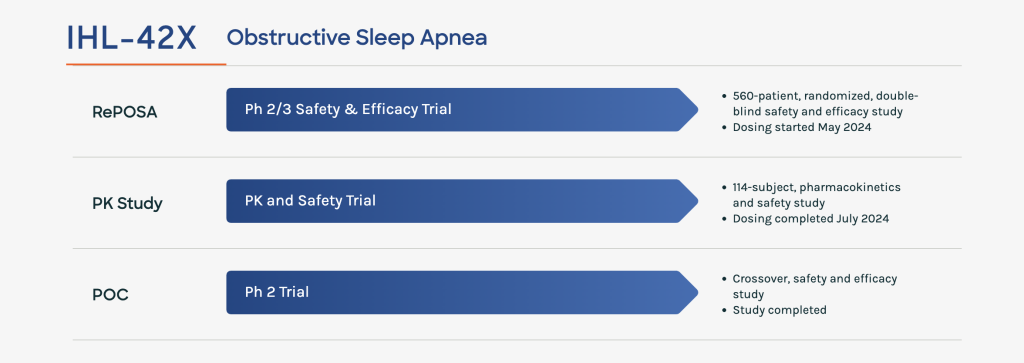
The Phase 2 RePOSA trial highlights Incannex’s emphasis on multidimensional evidence for a new respiratory therapy. In this 28‑day study, 121 adults with moderate‑to‑severe OSA received low‑dose IHL‑42X, high‑dose IHL‑42X, or placebo. Both dosing groups showed statistically significant reductions in apnea‑hypopnea index (AHI), with the high‑dose arm achieving reductions of up to 83% from baseline. These reductions, together with measurable improvements in oxygenation, indicate a substantial decrease in nocturnal respiratory events and associated physiological strain over the treatment period.

Efficacy was assessed using both objective and patient‑centered measures, in line with current expectations for respiratory drug development. Polysomnography provided detailed overnight assessment of sleep‑disordered breathing, confirming changes in AHI and oxygenation. In parallel, validated patient questionnaires evaluated sleep quality, daytime fatigue, and related symptoms. Structured patient exit interviews, conducted in alignment with FDA guidance on Patient‑Focused Drug Development, further contextualized these findings. Nearly 58% of participants reported improvements in their OSA, and almost 90% of those described these changes as meaningful in the context of daily life. By integrating rigorous overnight monitoring with structured qualitative and quantitative patient‑reported data, the program suggests that the physiological improvements observed in the sleep laboratory are associated with changes that patients perceive as relevant.
Safety and tolerability outcomes in RePOSA were consistent with the intended use of IHL‑42X as a potential chronic therapy. Across the 28‑day treatment period, the combination maintained a favorable safety and tolerability profile in the study population. Together, the polysomnographic data, questionnaire results, and exit interviews support the proposed dual mechanism of action of IHL‑42X and provide a coherent basis for advancing to late‑stage studies.
Rigorous late‑stage trial design for fixed‑dose respiratory combinations
The planned late‑stage development program for IHL‑42X reflects a stringent evidentiary approach to fixed‑dose combinations in respiratory disorders. Rather than evaluating only the combination product, Incannex intends to compare the selected fixed dose of IHL‑42X against each of its component active ingredients and against placebo in a larger OSA population. This design is structured to clarify the contribution of each component to overall efficacy and safety.
By separating the effects of dronabinol, acetazolamide, and their combination, the late‑stage program is designed to evaluate whether the effects seen in Phase 2 are supported and better understood in a comparative setting. This is particularly relevant in OSA, where pharmacologic options remain limited and the introduction of a combination therapy requires clear evidence on how each element affects ventilatory stability, airway control, and patient‑reported outcomes. Embedding such comparative rigor into the trial design sets a higher standard for fixed‑dose combination development in the respiratory field.

At the same time, the IHL‑42X program aligns with the company’s broader emphasis on cannabinoid‑based and psychedelic‑based therapies for chronic conditions, including respiratory disorders. The use of a synthetic cannabinoid within a purpose‑built fixed‑dose combination for OSA, coupled with detailed clinical and patient‑centered assessment, is presented by the company as an R&D model that may inform future programs within its pipeline. In this context, IHL‑42X illustrates how targeted mechanism selection, structured outcome measurement, and comparative late‑stage design can be integrated into a single clinical development strategy.
By linking a clearly articulated unmet clinical need to a dual‑mechanism oral therapy, generating Phase 2 data across both objective respiratory metrics and patient‑centered outcomes, and committing to a late‑stage trial design that assesses each component of the combination, Incannex Healthcare has positioned IHL‑42X as a differentiated investigational approach within the current OSA treatment landscape.

“This award recognizes the deliberate, science-driven approach we have taken to address one of the most persistent unmet needs in respiratory medicine. Obstructive sleep apnea has long relied on device-based management, yet a large proportion of patients remain untreated or undertreated in real-world practice. With IHL-42X, we set out to develop a purpose-built, oral combination therapy grounded in established sleep-respiratory physiology and supported by rigorous clinical and patient-reported evidence. We are proud that the Clinical Trials Arena Excellence Awards have acknowledged this work as we advance IHL-42X into late-stage development and continue to focus on delivering meaningful outcomes for patients.”
– Joel Latham, President and CEO
Company Profile
Incannex is leading the way in developing combination medicines that target the underlying biological pathways associated with chronic conditions, including obstructive sleep apnea, rheumatoid arthritis and generalized anxiety disorder. The company is advancing three clinical-stage product candidates based on evidence-based innovation and supported by streamlined operations. Incannex’s lead clinical program, IHL-42X, is an oral fixed-dose combination of dronabinol and acetazolamide designed to target underlying mechanisms and act synergistically in the treatment of obstructive sleep apnea. In a Phase 2 development program, IHL-675A is an oral fixed-dose combination of cannabidiol and hydroxychloroquine sulfate designed to act synergistically to alleviate inflammatory conditions, such as rheumatoid arthritis. Approved for Phase 2 clinical development, PSX-001 is an oral synthetic psilocybin treatment for the treatment of generalized anxiety disorder. Incannex’s programs target disorders that have limited, inadequate, or no approved pharmaceutical treatment options.
Contact Details
(212)655-0924
investors@incannex.com
media@incannex.com.au
Links
Website: https://incannex.com/

