
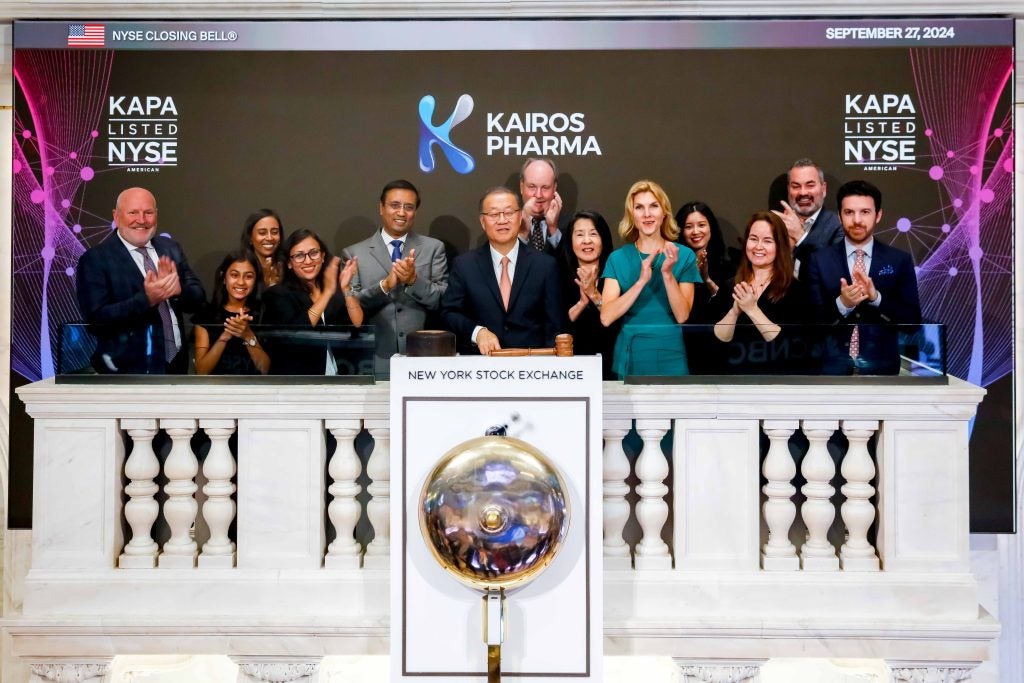
Photo Credit: NYSE
Kairos Pharma, a clinical-stage biopharmaceutical company spun out of Cedars-Sinai Medical Center, is focused on overcoming cancer drug resistance with targeted biologics. Its lead candidate, ENV‑105 (carotuximab), is a first‑in‑class CD105‑targeting antibody being developed as a resistance‑modulating therapy for metastatic castration‑resistant prostate cancer.
The company has advanced ENV‑105 into a structured Phase 2 trial, and emerging signals of clinical benefit, together with a combination‑suitable safety profile in patients progressing after standard hormone‑based treatments, have led to its recognition with the Research and Development award for Advanced Prostate Cancer, in the 2025 Clinical Trials Arena Excellence Awards.

Discover B2B Marketing That Performs
Combine business intelligence and editorial excellence to reach engaged professionals across 36 leading media platforms.
Reframing advanced prostate cancer R&D around treatment resistance
Kairos Pharma decided to focus directly on cancer drug resistance in mCRPC, rather than pursuing yet another incremental hormonal or cytotoxic agent. In this setting, disease progression despite androgen deprivation and second‑generation androgen receptor inhibitors is common, and subsequent treatment options often provide only temporary benefit with accumulating toxicity. Kairos has built its program around the role of CD105, a protein identified as a key driver of resistance to various cancer treatments and associated with cellular stress‑response and survival pathways.
ENV‑105 is designed not as a replacement for hormone therapy, but as a way to restore tumor sensitivity to it. By antagonizing CD105‑driven survival signaling that emerges after androgen‑deprivation or targeted hormone therapy, ENV‑105 aims to extend the effective duration of agents such as apalutamide in patients whose disease has already progressed on prior hormone‑based regimens. This resistance‑focused approach contrasts with the more common pattern of cycling patients through different hormonal agents, radioligand therapy, or chemotherapy once resistance develops.

The mechanism has shown early evidence of synergy with apalutamide in men who had progressed on at least one earlier androgen receptor inhibitor. ENV‑105, thus, reflects a shift from concentrating solely on the tumor to targeting the underlying biology that allows it to adapt and survive standard treatment. This conceptual reframing is aligned with Kairos’s broader pipeline, which is also focused on overcoming resistance and immune suppression in difficult‑to‑treat cancers.
Meaningful progression‑free survival and safety in late‑line mCRPC
The interim clinical data from Kairos Pharma’s Phase 2 trial in advanced prostate cancer were another key factor in its recognition. In a predefined interim analysis in men with mCRPC who had failed at least one androgen receptor inhibitor, the combination of ENV‑105 with standard‑of‑care hormone therapy apalutamide achieved a median progression‑free survival of more than 13 months in the evaluable population. In an earlier company update, this was reported as a median PFS of approximately 13.7 months. All responders remained progression‑free for at least four months, and approximately half of these responders remained progression‑free beyond one year.
These results compare favorably with typical expectations for second or third‑line hormone therapy in this setting. In the CARD trial, often cited as a benchmark, subsequent hormone therapy after prior androgen receptor inhibitors was associated with a median PFS of 3.7 months, while cabazitaxel chemotherapy provided a median PFS of eight months, with greater toxicity. The ENV‑105 Phase 2 study is statistically powered to detect a 45% improvement in PFS over the 3.7‑month hormone therapy benchmark, corresponding to an increase to 6.7 months. The interim signal with ENV‑105 and apalutamide exceeds this target at the current stage of follow‑up. While cross‑trial comparisons have inherent limitations, these data suggest that the combination may extend the period of disease control beyond what is typically seen with later‑line hormone sequencing.
Additional activity measures support these findings. The interim efficacy analysis showed clinical benefit in 86% of treated patients. Seven of nine evaluable patients experienced reductions in prostate‑specific antigen (PSA) levels from baseline. All responders remained progression‑free for at least four months on treatment. For a population that had already exhausted at least one androgen receptor inhibitor, this degree of durability while continuing hormone‑based therapy is clinically notable.
Equally important is the safety profile observed so far. In the initial safety cohort of the Phase 2 trial, which enrolled ten patients, ENV‑105 in combination with apalutamide was reported to be well tolerated. There were no dose‑limiting toxicities, no unexpected adverse events, and no Grade 4 or 5 adverse events observed in its broader interim reporting. Treatment‑related side effects were manageable with standard supportive care.
Tolerability is crucial for a therapy used in combination with existing hormonal agents. A resistance‑modifying antibody that can be layered onto standard hormone therapy without introducing significant new toxicity is more readily integrated into routine care for older, often comorbid patients with mCRPC. The emerging safety and efficacy data support the ongoing conduct of the randomized Phase 2 program, which aims to enroll up to 100 patients at centers including Cedars‑Sinai, City of Hope, and the Huntsman Cancer Institute.
Advancing CD105 resistance biology into a scalable clinical strategy
Another dimension of the recognition is Kairos Pharma’s progress in moving CD105‑focused resistance biology from preclinical theory into a structured clinical program with clear objectives. CD105 has been identified by the company as a key driver of resistance across multiple cancer types, with elevation in response to standard therapies associated with relapse and treatment failure. ENV‑105, an antibody targeting CD105, is being tested in a Phase 2 trial in castration‑resistant prostate cancer and in a Phase 1 trial for lung cancer, with the intention of addressing resistance in both settings.
The prostate cancer Phase 2 study is designed with explicit comparative and statistical goals. The randomized trial plans to enroll approximately 100 men whose disease has progressed on standard hormone‑based therapies. It is powered to demonstrate a 45% improvement in PFS over the 3.7‑month benchmark associated with later‑line hormone therapy alone, and includes predefined interim analyses focused on safety and early efficacy. This design provides a framework for assessing whether ENV‑105 can deliver a clinically relevant extension of hormone therapy benefit, while also generating the type of data needed to inform future regulatory discussions about a potential pivotal Phase 3 program.
The development of ENV‑105 also fits into a broader portfolio strategy at Kairos Pharma. Alongside ENV‑105, the company is advancing assets aimed at modulating T‑cell responses, targeting cancer stem cells, and addressing other resistance and immune‑suppression mechanisms. ENV‑105 is being developed as a resistance‑modifying agent that could, in principle, be combined with existing standards of care across different tumor types, with prostate cancer as the lead indication where human proof‑of‑concept is emerging.

“ENV-105 is unique in its mechanism and strategic integration with current standards of care. For too long we’ve seen drug resistance as inevitable and turned to new therapies when existing and effective treatments have faltered. By directly addressing the biological mechanisms that drive resistance, we now have the potential to extend the effectiveness of standard-of-care therapies, reduce relapse risk, and offer new hope to patients with few remaining options.”
– John Yu, CEO of Kairos Pharma
Company Profile
Kairos Pharma is a clinical-stage biopharmaceutical company developing ENV-105, a first-in-class therapeutic candidate designed to address one of oncology’s most pressing challenges, cancer treatment resistance. Cancer drug resistance remains a leading cause of initially positive therapeutic failure across tumor types, driven by complex biological mechanisms that allow cancer cells to evade, adapt to, or recover from standard treatments. ENV-105 targets the cellular stress-response and survival pathways that fuel this resistance, with the goal of restoring sensitivity to existing therapies and enabling more durable patient outcomes. By focusing on the root causes of resistance rather than the tumor alone, ENV-105 represents a novel and highly innovative approach in next-generation cancer therapy development, allowing already approved treatments to remain effective for longer.
Contact Details
CORE IR
investors@kairospharma.com
Links
Website: https://kairospharma.com/

