
WCG CEO Sam Srivastava explains how the company’s award‑winning ClinSphere® eReview Manager is reinventing ethics review as an AI‑enabled, interoperable, and data-driven workflow. In this candid conversation, he outlines how WCG is pairing accredited IRB governance with modern UX, APIs, and analytics to cut submission times, ease site burden, and prepare the industry for AI-heavy protocols, all while deepening WCG’s edge over both regional IRBs and tech‑only challengers.
WCG is a global expert in efficient and ethical trials and winner of the Innovation Award in the 2025 Clinical Trials Arena Excellence Awards.
Go deeper with GlobalData


Discover B2B Marketing That Performs
Combine business intelligence and editorial excellence to reach engaged professionals across 36 leading media platforms.
Clinical Trials Arena (CTA): Congratulations on winning the 2025 Innovation award for Ethics Review. What industry problem did ClinSphere® eReview Manager decisively solve, and why was now the inflection point to tackle it?

Sam Srivastava: As a global leader in accelerating clinical research, WCG set out to build WCG ClinSphere®, a trailblazing approach to running clinical trials end-to-end. Leveraging the power of artificial intelligence, the platform connects sites, sponsors, CROs, and participants in one unified cloud platform.
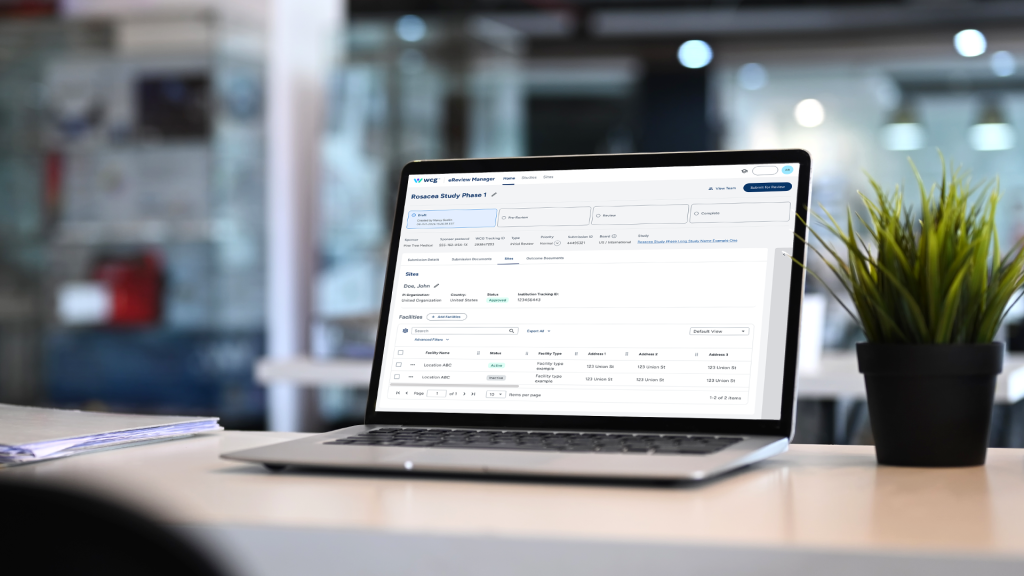
eReview Manager was purpose-built on the ClinSphere® platform to address persistent inefficiencies in IRB review, including fragmented communications, slow document handling, and error-prone data entry. The inflection point came as clinical research teams faced, and continue to face, mounting pressure for speed, transparency, and regulatory rigor. The platform replaces email handoffs with a real-time collaborative workspace, protocol-aware questionnaires, and a pre-review quality stage, streamlining every step from submission to decision. This has been a multi-year project to build a completely new solution that encompasses client feedback and our nearly 60 years as the leading expert in IRB review.
CTA: How does this win align with WCG’s long-term vision for modernizing research governance, beyond IRB into broader HRPP and regulatory operations?
Sam Srivastava: The launch of eReview Manager extends beyond IRB review, supporting broader HRPP and regulatory operations by integrating smart workflows, deep data visibility, and collaborative tools. This aligns with WCG’s vision to deliver expertise, technology and AI-enabled solutions that empower sponsors, CROs, and sites to advance innovative therapies swiftly and safely, setting new standards for operational excellence and compliance. WCG prioritizes operational efficiencies that enhance our deep, focused commitment to ensuring the utmost safety and protection of participants at every stage of research.
CTA: Many platforms promise speed; you emphasize speed with rigor. What governance choices or controls did you refuse to compromise on while building eReview Manager?
Sam Srivastava: To further stand by our commitment to quality and safety, eReview Manager includes a pre-review stage, protocol-aware questionnaires, and completeness indicators. Additionally, submissions are reviewed by WCG’s AAHRPP-accredited, ISO 9001-certified board, ensuring independence and quality. WCG prioritizes traceability, data integrity, and regulatory compliance, in order to balance speed with the rigor expected in ethics review.
CTA: What measurable changes have clients seen at portfolio scale since adopting the platform?
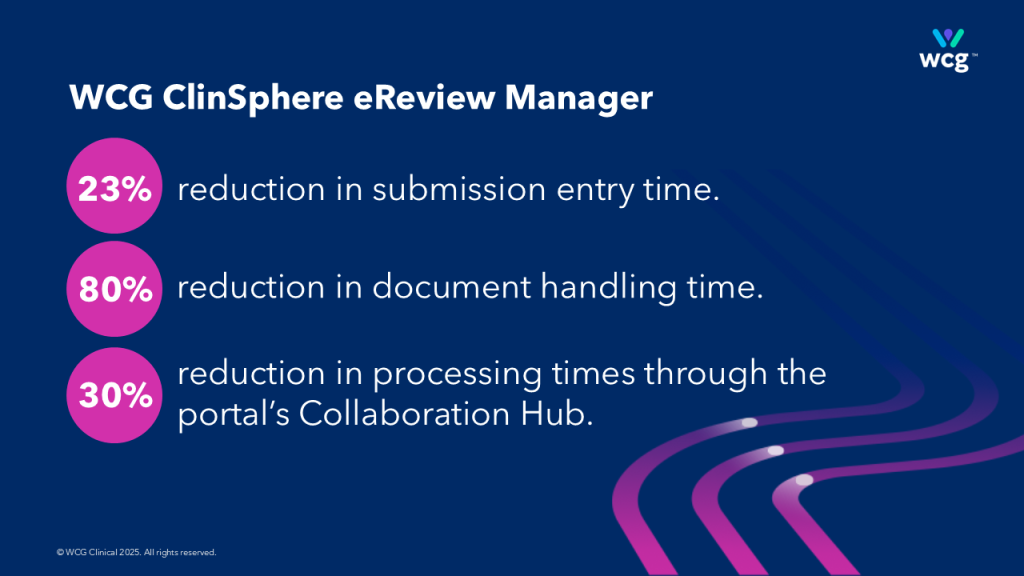
Sam Srivastava: One of the key pain points in the review process is the extensive timeline in submitting. Early adopters of eReview Manager reported a 23% reduction in submission entry time, up to 30% faster processing using the collaboration hub, and up to 80% reduction in document download time. By reducing unnecessary time spent, users can expedite the submission process, reduce errors, and maintain quality.
CTA: Where did you face the toughest adoption hurdles (process, change management, data standards), and how did WCG overcome them with sponsors, CROs, and sites?
Sam Srivastava: With any new product, there will be challenges and growing pains. The toughest hurdles we encountered were building an entirely new system that was on par with, and ultimately exceeded, the quality and experience of our legacy system, WCG Connexus, and onboarding teams using that system. We overcame these challenges by providing phased onboarding and comprehensive training, offering client-care support and guidance at every step, and designing intuitive workflows and a user-friendly workspace to ease the transition.
CTA: How are you using operational data and user telemetry from eReview Manager to inform product roadmap and evidence of impact?
Sam Srivastava: Operational data and user telemetry from eReview Manager are essential in shaping our product roadmap and demonstrating real-world impact. We leverage these insights to benchmark performance across workflows, allowing us to identify bottlenecks and optimize processes for greater efficiency. By analyzing user behavior and gathering feedback, we are able to guide feature enhancements to address the evolving needs of our clients and users. Additionally, the measurable data and transparent insights we generate offer tangible value to sponsors, CROs, and sites, enabling informed decision-making and continuous improvement in ethics review management. This data-driven approach ensures eReview Manager not only meets industry standards but continues to advance efficiency and effectiveness in clinical research.
CTA: What does the combination of WCG’s accredited boards and an in-platform collaboration hub enable that third-party tools or email workflows cannot?
Sam Srivastava: The combination of WCG’s accredited boards and an in-platform collaboration hub enables a centralized history of all communications and decisions, streamlining clinical trial workflows far beyond what third-party tools or email processes can offer. By minimizing the need to switch between portals and email systems, users benefit from immediate in-app access to IRB experts for clarifications and issue resolutions, ensuring that questions are addressed efficiently. This integrated approach significantly enhances audit readiness, as all records are securely maintained within a single, accessible platform. Additionally, it eliminates gaps or delays in the submission process, even if team resources change or personnel are out of the office, providing continuity and reliability essential for accelerating research timelines.
CTA: Can you share a concrete example where real-time visibility changed a critical timeline decision—such as site activation sequencing or resource reallocation?
Sam Srivastava: Timeline visibility is critically important in all areas of clinical research, but one of the places it is most impactful is in Phase I trials. Frequently, there will be a trial participant on site awaiting treatment, and processing the change in research at the IRB is the piece needed to proceed. Having clear visibility to when this will be received ensures the best care for the participant.
CTA: How do you approach interoperability with eTMF, CTMS, EDC, and site systems to minimize duplicate data entry and preserve audit trails?
Sam Srivastava: eReview Manager is purposely designed for seamless API integration with eTMF, CTMS, EDC, and site systems, ensuring robust interoperability across clinical trial technologies. Through automated data flow and real-time synchronization, the platform eliminates redundant data entry, enabling teams to work more efficiently and reducing the risk of errors. This integration supports the preservation of comprehensive audit trails, thereby facilitating regulatory compliance and transparency. Additionally, eReview Manager streamlines document management across platforms, ensuring that workflows remain consistent and documents are easily accessible, further enhancing oversight and operational efficiency in clinical research.
CTA: In an era of increasing scrutiny, how do you ensure privacy, security, and compliance while maintaining a consumer-grade user experience?
Sam Srivastava: To ensure privacy, security, and compliance while maintaining a consumer-grade user experience, we host our solutions on a secure, compliant platform that is AAHRPP-accredited and ISO 9001-certified. We utilize single sign-in with Multi-Factor Authentication (MFA) to safeguard user access, adding an essential layer of protection. Furthermore, our system incorporates role-based permissions, ensuring that users only access data and features relevant to their responsibilities. This comprehensive approach provides robust security and regulatory compliance, while still delivering an intuitive, user-friendly interface for all participants in the clinical trial process.
CTA: Looking ahead 12–24 months, what new capabilities will matter most for ethics review operations—automation, structured content, standards like HL7 FHIR, or something else?
Sam Srivastava: Looking ahead 12–24 months, the most important capabilities for ethics review operations will be enhanced integrations with both internal and external systems, as well as expanded analytics and benchmarking tools for continuous improvement. These advancements will facilitate more efficient data exchange, promote greater interoperability, and enable ethics review teams to derive actionable insights for ongoing optimization. By focusing on deeper integrations and analytics, organizations will be better equipped to streamline workflows, uphold regulatory standards, and maximize the quality and impact of their research processes.
We also need to be prepared for the future of AI and how that impacts ethics review. WCG has partnered with the Multi-Regional Clinical Trials Center of Brigham and Women’s Hospital and Harvard (MRCT Center) to lead a multi-stakeholder task force to address ethical and regulatory challenges in the IRB review of protocols that use AI. Together, we’ve created a framework that offers IRBs and other oversight entities a structured, practical approach to evaluating protocols that involve artificial intelligence in research with human participants. The framework addresses emerging ethical and regulatory challenges specific to AI, like algorithmic bias, adaptive learning, data identifiability, and the need for human oversight, while aligning with foundational ethical principles and applicable U.S. regulations.
CTA: How does this product advance WCG’s differentiation versus regional IRBs or tech only entrants—where do you see your moat deepening?
Sam Srivastava: eReview Manager advances WCG’s differentiation by leveraging our accredited, independent single IRB review board, setting a high standard compared to regional IRBs and tech-only entrants. With nearly 60 years of expertise and best-in-class support, WCG offers a depth of institutional knowledge and reliability that few can match. Additionally, our access to unmatched trial intelligence empowers clients to make data-driven decisions that accelerate research timelines and improve outcomes. As we continue to integrate these strengths, our competitive moat deepens, delivering greater value through trusted oversight, expert guidance, and powerful analytics that shape the future of ethical review in clinical research.
CTA: How are you empowering sites, which often bear the heaviest admin load, to benefit equitably from these efficiencies?
Sam Srivastava: eReview Manager features smart workflows that significantly reduce the need for entering redundant or irrelevant study information, thereby streamlining the process for site staff. Real-time tracking and robust intrateam collaboration tools help eliminate siloed communications and minimize delays, ensuring seamless coordination and responsiveness. The ability to handle bulk documents and generate comprehensive reports greatly reduces administrative workload, freeing site teams to focus on more critical tasks. Most importantly, eReview Manager delivers transparent, actionable insights at the site level, enabling each site to operate more efficiently and benefit equitably from these innovations, ultimately enhancing their impact on advancing clinical research.
CTA: What call to action would you offer sponsors and CROs evaluating the next generation of ethics review technology?
Sam Srivastava: For sponsors and CROs evaluating the next generation of ethics review technology, we encourage them to embrace IRB solutions that combine speed with uncompromising rigor. Prioritize platforms that offer smart workflows, real-time collaboration, a streamlined user experience, and robust document management and reporting capabilities, all of which are vital to maximizing efficiency without sacrificing quality or compliance. I invite you to see how this innovative solution can accelerate IRB review and study management processes while safeguarding participant safety and ethical standards. I am excited, and hope you all are as well, for this next step in improving ethical review.
CTA: Thank you, Sam, for distilling what “next-generation” ethics review should look like in practice. Your focus on combining accredited oversight with AI-enabled, interoperable technology gives our readers a clear benchmark for what to prioritise as they evaluate new solutions, and it underlines why ClinSphere® eReview Manager is emerging as a compelling option for sponsors, CROs, and sites looking to modernize IRB operations.
About Sam Srivastava
Sam is a transformative healthcare executive with a proven track record of driving growth and innovation in healthcare delivery. Sam has a passion to deliver better healthcare and is committed to leading with compassion. Prior to WCG, he served as the CEO of NeueHealth and COO for Bright Health, leading strategy, development, integration, and operations.



