

Pharmaceutical companies increasingly require more scalability and precision in managing their clinical supply chain. Such demands necessitate stronger, more impactful working relationships to ensure supply chain resilience and for pharma companies to be aware of potential challenges before they become issues that disrupt supply chains.
Discussions around the importance of fostering strong relationships across the clinical supply ecosystem, and their evolving nature, were a recurrent topic of conversation at Arena International Event Group’s Clinical Trial Supply (CTS) Europe conference, which took place in Barcelona, Spain on 24 and 25 February.
Go deeper with GlobalData


Discover B2B Marketing That Performs
Combine business intelligence and editorial excellence to reach engaged professionals across 36 leading media platforms.
To address the increasing scale and complexity of clinical supply chain operations, Karine Gradziel, chief commercial and marketing officer for DHL subsidiary CRYOPDP, highlights that its clients are nowadays more willing to have “one central point” and one partner to manage all of these factors.
During an interview with Clinical Trials Arena, Gradziel notes that single partners to manage the supply chain tended not to exist in the past.
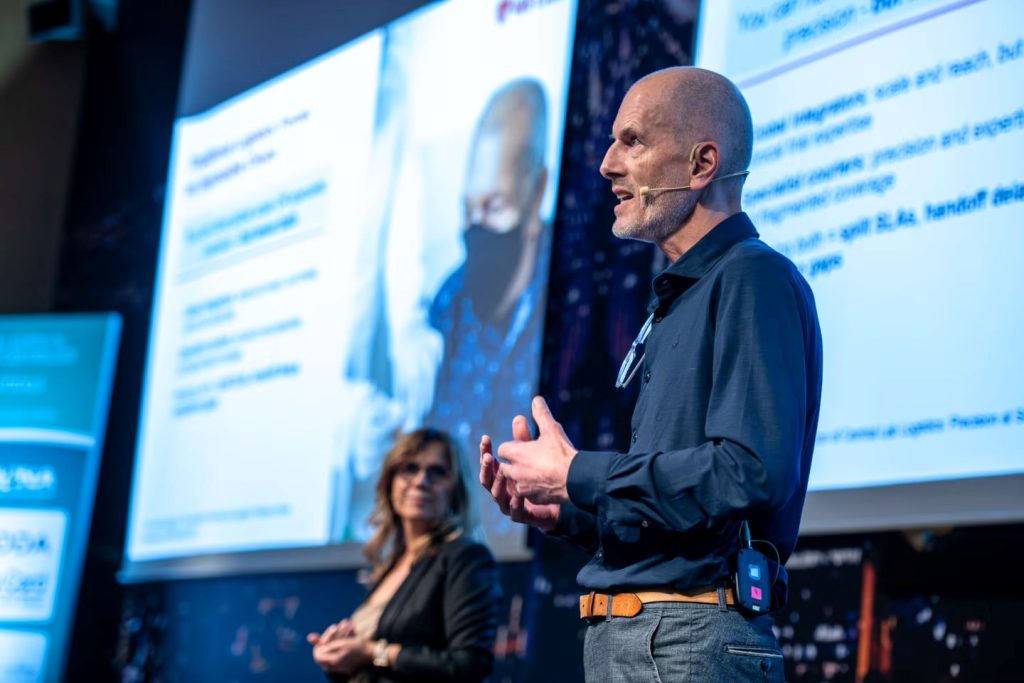
“A few years ago, clients would agree to integrate our specialists into their operations, but now, there is a strong will to have one central partner that is able to manage the supply chain end-to-end,” Gradziel says.
In meeting more complex demands, such as the growing requirement to transport biologics that require storage from ambient down to cryogenic temperatures, DHL acquired CRYOPDP in March 2025 to strengthen its health logistics business.
US Tariffs are shifting - will you react or anticipate?
Don’t let policy changes catch you off guard. Stay proactive with real-time data and expert analysis.
By GlobalData“CRYOPDP and DHL now work together to provide the whole range of temperature logistics options required, to meet the complexity and growing demands around transporting biologics such as cell and gene therapies (CGTs),” notes Gradziel.
DHL is also becoming more of a consultative partner to its clients to deal with factors such as geopolitical and regulatory uncertainty that could problematise aspects of the clinical supply chain for its clients, such as the Trump Administration’s imposition of tariffs throughout 2025.
Marco Flapper, life science program and business development manager for DHL Express, highlights that DHL now engages more regularly with relevant authorities than it did in the past, in order to get the “best firsthand information possible” about factors that may cause challenges for their clients.
“We have taken up this role to get necessary information and intelligence as soon as possible, to share with our customers to help them to anticipate what measures they need to take to maintain their supply chain resilience,” explains Flapper.
Flapper concludes that finding solutions to overcome challenges being faced in the supply chain has become “the majority” of the company’s role.
“Anyone can transport something from A to B, but it’s how you do it, and what circumstances and roadblocks you have to surmount,” Flapper says.
Engaging all stakeholders in the clinical supply chain ecosystem
How to go about forging strong, practical relationships with all stakeholders within the clinical supply chain ecosystem was another factor under discussion at CTS Europe as a means to ensure supply chain resilience and success.
During a panel conversation on CTS’s mainstage, Luiz Barberini, head of external manufacturing, Latin America at Bayer, highlights that you “can’t design the future of clinical trials if you don’t engage your partners”.
“Engagement must start in the early steps of the relationship, and this means bringing personnel from areas such as procurement and R&D together,” Barberini says.
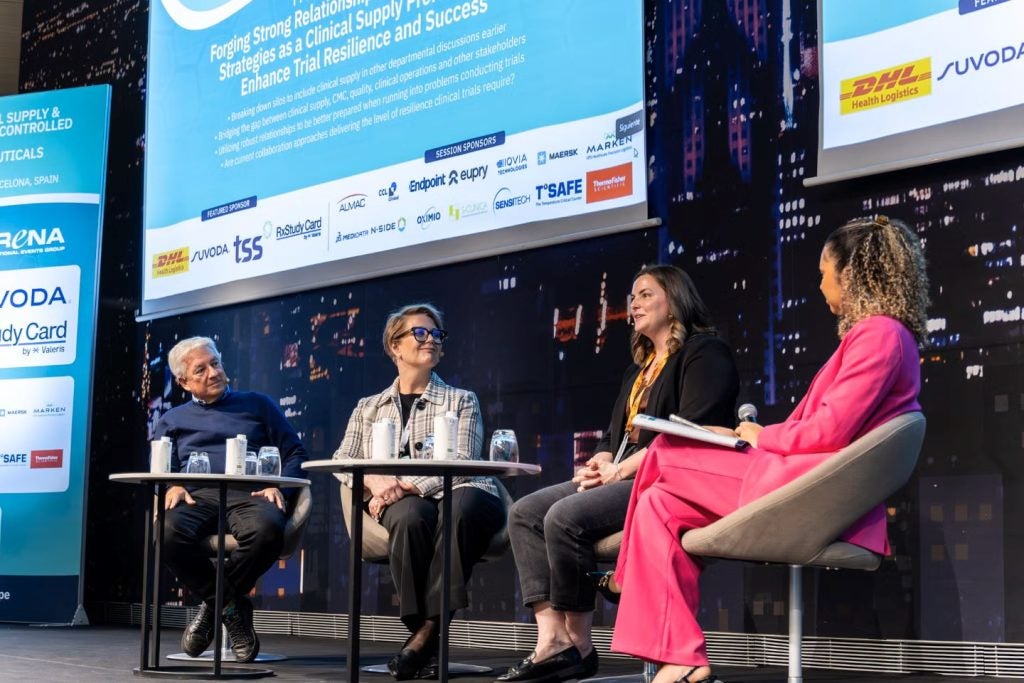
“They have to align the concepts that they have in order to bring the right partnership to the table. And the whole point of this is to get them engaged in your process and your projects – to ensure that everyone involved in the supply ecosystem is on the same page,” Barberini continues.
Speaking on the same panel, Gemma Lofts, director for the clinical supply chain at Bicycle Therapeutics, highlights that in terms of governance, initiating a high-level process internally around establishing key performance indicators (KPIs) with key strategic partners is key to ensuring the supply chain operates smoothly.
She says: “See the KPIs as a positive. If you work on them together, you can start seeing trends when you’re reviewing them on a quarterly basis, so you can maintain your partner relationships in a strong and measurable way.”
Lofts also highlights the value of “information communication” to foresee upstream-downstream issues in the supply chain that may have a knock-on effect on overall operations.
“The sooner you hear about an issue, the quicker you can react, but the amount of information you’re provided with also has an impact,” Lofts says.
“With strong vendor relationships, you can both be very open, you can come to a solution a lot quicker than only hearing half of the story. If people aren’t fully transparent, it becomes a lot harder to react and fix an issue,” Lofts adds.
Open communication with CMOs
During a session on the second day on CTS’s mainstage, Philip Coetzee, director of CMO management at Daiichi Sankyo, emphasises the importance of open communication between pharma companies and their contract manufacturing organisations (CMOs) as the best way of finding a solution.
To illustrate this point, Coetzee relayed a story wherein a CMO was tasked with developing a syringe and bottle solution for the administration of a medicine for children; however, in terms of measuring the medicine most effectively across different weight groups, a sachet-based solution was ultimately the most appropriate solution for ease-of-use and dosing, as opposed to the bottled solution that ultimately failed.
In Coetzee’s view, the right solution was lost in the fog because the pharma, so convinced that their approach was the right one, didn’t listen, or chose “not to hear” what the CMO was advising.
“Many of the big pharma companies have this attitude with their CMO of ‘I speak, you listen; I say, you do’”, Coetzee says.
“That’s wrong, because at the end of the day, the CMO will agree to whatever is requested, but that’s not a win. Open communication surrounding their viewpoints and capabilities is right.”
Interested in attending or sponsoring an upcoming Arena event? Complete the form below and our team will be in touch.



