
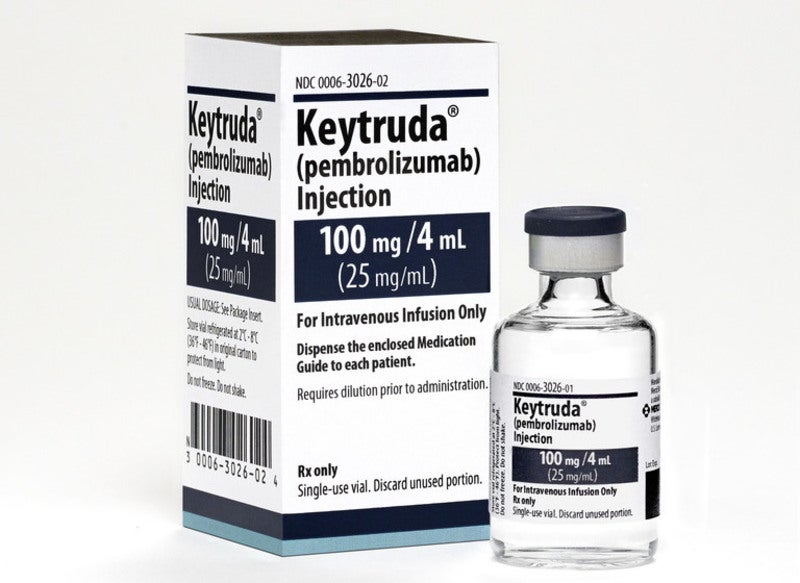
Merck has reported positive results from the Phase III KEYNOTE-181 clinical trial of its keytruda drug in previously treated patients with advanced oesophageal or oesophagogastric junction carcinoma.
Keytruda is an anti-PD-1, humanised monoclonal antibody designed to boost the immune system’s ability to identify and fight tumour cells.
Go deeper with GlobalData


Discover B2B Marketing That Performs
Combine business intelligence and editorial excellence to reach engaged professionals across 36 leading media platforms.
The drug met the primary endpoint of significant improvement in overall survival (OS), leading to 31% decrease in the risk of death compared to chemotherapy.
The improved OS was observed in squamous cell carcinoma or adenocarcinoma patients who progressed after undergoing standard therapy and whose tumours expressed PD-L1.
However, patients with squamous cell histology and in the entire intention-to-treat (ITT) trial population did not achieve directionally favourable, statistical significance for OS.
Merck will present the trial results at the 2019 Gastrointestinal Cancers Symposium.

US Tariffs are shifting - will you react or anticipate?
Don’t let policy changes catch you off guard. Stay proactive with real-time data and expert analysis.
By GlobalDataMerck Research Laboratories chief medical officer Roy Baynes said: “Oesophageal cancer often progresses aggressively, so we are encouraged to see these overall survival results for keytruda as monotherapy in previously treated patients.
“Along with other new data for keytruda and from our broad oncology portfolio, we are pleased to share our latest clinical research in gastrointestinal cancers at ASCO GI.”
The randomised, open-label KEYNOTE-181 trial assessed the drug as monotherapy for the second-line treatment in a total of 628 patients.
Primary endpoint of the trial is OS, while secondary endpoints are progression-free survival (PFS), objective response rate (ORR) and safety/tolerability.
Merck’s clinical research programme for keytruda includes more than 900 trials across various cancers and treatment settings. The programme aims to gain better insights into the drug’s role across cancers as well as factors that could help predict a patient’s response to its therapy.
The drug is also being studied for oesophageal cancer treatment in a Phase III KEYNOTE-590 trial.



