
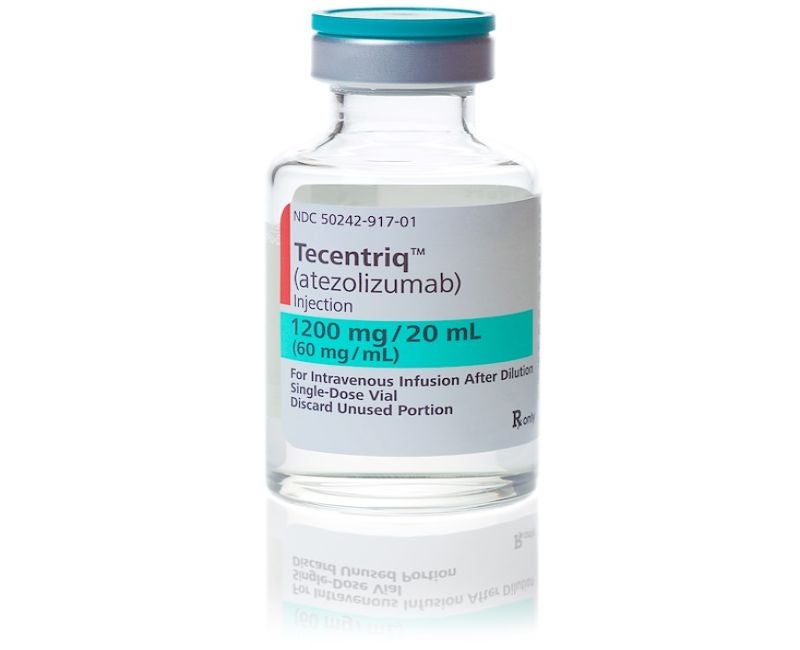
Results from the Phase III IMvigor010 clinical trial have revealed that Roche’s Tecentriq (atezolizumab) did not meet the primary endpoint as an adjuvant monotherapy in muscle-invasive urothelial cancer (MIUC) patients.
Tecentriq is an anti-PD-L1 monoclonal antibody designed to allow T-cell activation. The cancer immunotherapy holds approvals to treat lung, urothelial and breast cancers.
Go deeper with GlobalData


Discover B2B Marketing That Performs
Combine business intelligence and editorial excellence to reach engaged professionals across 36 leading media platforms.
The open-label, randomised, controlled IMvigor010 trial compared the safety and efficacy of Tecentriq to observation in 809 patients at high-risk for recurrence after resection.
The primary endpoint of the study was disease-free survival (DFS), determined as the time from randomisation to invasive urothelial cancer recurrence or death.
Roche said that its Tecentriq monotherapy failed to meet the endpoint but showed a safety profile consistent with its known profile and without any new safety signals.
Urothelial cancer constitutes approximately 90%-95% of all bladder cancer cases. MIUC is an urothelial cancer that has spread into the muscle of the bladder, ureter or renal pelvis.

US Tariffs are shifting - will you react or anticipate?
Don’t let policy changes catch you off guard. Stay proactive with real-time data and expert analysis.
By GlobalDataEarly treatment for MIUC is required to decrease the risk of cancer recurrence or metastasis. Within two years of surgery, nearly 50% of MIUC patients experience recurrence, indicating the need for alternative treatment options.
Roche chief medical officer and Global Product Development head Levi Garraway said: “Reducing the risk that muscle-invasive urothelial cancer will recur after surgery is very difficult, and we are disappointed that we were not able to significantly prolong disease-free survival.
“We remain committed to exploring the potential benefits of immunotherapy for more people with early cancers.”
Last month, the company reported positive results from the Phase III IMspire150 trial of Tecentriq in combination with Cotellic (cobimetinib) and Zelboraf (vemurafenib) in treatment-naive BRAF V600 mutation-positive advanced melanoma patients.



