

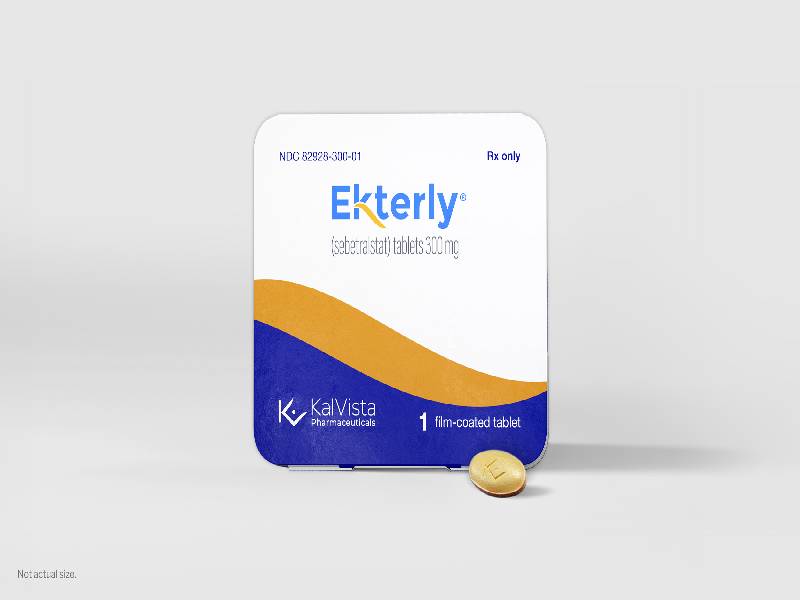

EKTERLY® (sebetralstat) is a plasma kallikrein inhibitor indicated for the treatment of acute hereditary angioedema (HAE) attacks in adults and in children aged 12 years and above.
Developed by KalVista Pharmaceuticals, EKTERLY (sebetralstat) is supplied as 300mg, yellow, oval, biconvex, film-coated oral tablets to be taken at the earliest signs of an attack.
Recommended Buyers Guides

Regulatory approvals for EKTERLY
In July 2025, the US Food and Drug Administration (FDA) approved EKTERLY (sebetralstat) for the treatment of acute HAE attacks in adult and paediatric patients aged 12 years and older.
The Medicines and Healthcare products Regulatory Agency (MHRA) in the UK also granted marketing authorisation for EKTERLY during the same month.
The European Medicines Agency (EMA) granted marketing authorisation for sebetralstat in the European Union in September 2025 after the Committee for Medicinal Products for Human Use (CHMP) issued a positive opinion recommending marketing authorisation of the drug in July 2025. The drug holds an orphan drug designation from the EMA.
In September 2025, Swissmedic, the Swiss Agency for Therapeutic Products, also approved the medicine in Switzerland.
HAE causes and symptoms
HAE is a rare inherited disorder resulting from a genetic defect that leads to deficiency or dysfunction of the plasma protein C1 inhibitor (C1-INH), causing uncontrolled activation of the kallikrein–kinin system.
People with HAE experience episodes of tissue swelling at different body sites, which may become life-threatening depending on the area involved. Attacks vary between individuals and may be triggered by factors such as stress or physical trauma. Although attacks are unpredictable, early symptoms can include tightness, swelling, non-itchy rash, pressure, pain or aching, tingling and fatigue.
Treatment guidelines include treating attacks as early as possible to limit swelling progression and shorten time to resolution, and recommend considering treatment for all attacks regardless of location or severity.
EKTERLY’s mechanism of action
Sebetralstat is a competitive, reversible inhibitor of plasma kallikrein, which is a serine protease that cleaves high molecular weight kininogen (HK), releasing bradykinin.
In HAE patients, plasma kallikrein activity is increased, leading to elevated levels of bradykinin.
Bradykinin causes dilation and increased permeability of blood vessels, allowing fluid to move into surrounding tissues and leading to angioedema attacks.
Sebetralstat inhibits HK cleavage and reduces bradykinin production, treating the clinical manifestations of an acute HAE attack.
The drug also inhibits the positive feedback loop of the kallikrein–kinin system mediated by plasma kallikrein, thereby reducing the generation of factor XIIa and additional plasma kallikrein.
Clinical trials on EKTERLY
The efficacy of EKTERLY for treating acute HAE attacks in adults and paediatric patients aged 12 years and older was assessed in KONFIDENT, a Phase III, double-blind, randomised, placebo-controlled, multi-centre trial.
KONFIDENT used a three-way, complete crossover design comparing EKTERLY 600mg and EKTERLY 300mg with a placebo. Trial participation lasted around 25 weeks. A total of 110 patients were randomised and experienced at least one HAE attack.
Among 264 treated attacks, 142 (54%) involved only peripheral symptoms, 85 (32%) only abdominal symptoms, 27 (10%) both abdominal and peripheral symptoms, eight (3%) mild to moderate laryngeal symptoms, and two (1%) had missing location data.
The primary endpoint of the clinical trial was time to the beginning of symptom relief, defined as at least “a little better” at two consecutive time points within 12 hours of the first dose, measured using the seven-point Patient Reported Global Impression of Change (PGI-C) scale ranging from “much worse” to “much better”.
The primary endpoint of time to the beginning of symptom relief was significantly shorter with EKTERLY 600mg than with placebo.
Overall, 71 of 93 (76%) patients receiving EKTERLY 600mg and 41 of 84 (49%) receiving placebo met the primary endpoint. The median time to the beginning of symptom relief within 12 hours of the first dose was two hours (95%) in the EKTERLY 600mg group.
The trial also included two key secondary endpoints. The first secondary endpoint was time to first reduction in severity at two consecutive time points within 12 hours of the first dose, assessed using the five-point Patient Global Impression of Severity (PGI-S) scale from “none” to “severe”.
The time to first reduction in severity was significantly shorter with EKTERLY 600mg than with placebo.
A total of 49 of 93 (53%) patients in the EKTERLY 600mg group and 26 of 84 (31%) in the placebo group achieved this endpoint within 12 hours. The median time was 9.1 hours (95%) in patients receiving EKTERLY 600mg.
The second key secondary endpoint was time to attack resolution, defined as a PGI-S score of “none” within 24 hours of the first dose.
The time to attack resolution was significantly shorter with EKTERLY 600mg than with placebo. In total, 46 of 93 (49%) patients receiving EKTERLY 600mg, and 23 of 84 (27%) receiving placebo achieved attack resolution within 24 hours.
Time to onset of at least “better” at two consecutive time points on the PGI-C within 12 hours of the first dose was also evaluated.
This endpoint was achieved by 54 of 93 (58%) patients in the EKTERLY 600mg group and 21 of 84 (25%) in the placebo group. The median time was 4.6 hours (95%) in patients receiving EKTERLY 600mg.
Further clinical trials on EKTERLY
KONFIDENT-KID is an ongoing open-label trial of sebetralstat in paediatric patients aged two to 11 years with HAE.
The study enrolled around 26 patients aged two to 11 years across seven countries in North America, Europe and Asia.
Interim findings from 65 attacks treated in 26 children receiving weight-based oral dosing of sebetralstat showed a mean of 0.8 attacks per month. In the 150mg cohort, median time to symptom relief was 1.5 hours.
The KONFIDENT-S trial is an ongoing, open-label, Phase III extension study of up to two years, including 69 participants from 15 European countries who have treated a total of 999 attacks with sebetralstat.
Interim analysis showed a median time to treatment of 16 minutes overall and ten minutes for adolescents aged 12 to 17 years. Median time to onset of symptom relief was 1.6 hours.
