

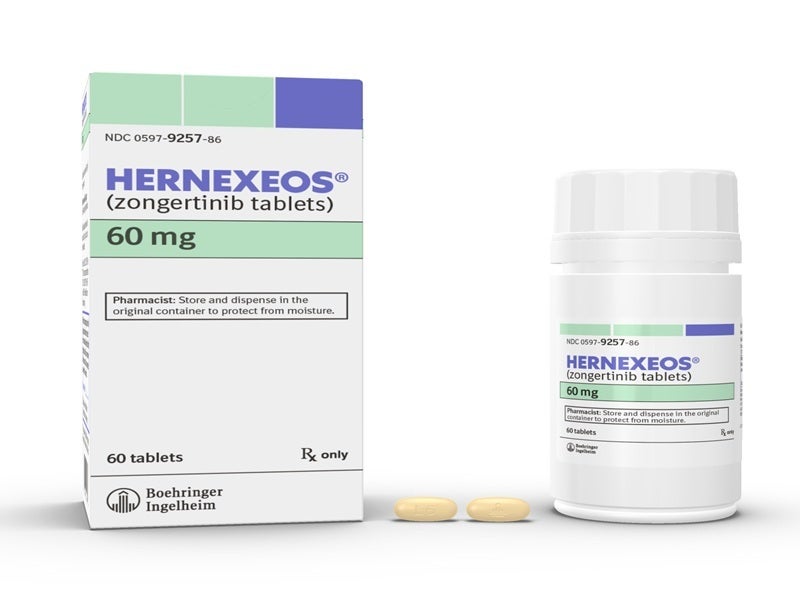

HERNEXEOS® (zongertinib tablets) is a selective tyrosine kinase inhibitor (TKI) indicated for the treatment of adult patients with unresectable or metastatic non-small cell lung cancer (NSCLC) with HER2 (ERBB2) tyrosine kinase domain (TKD)-activating mutations.
Comprehensive biomarker testing using next-generation sequencing determines a patient’s eligibility for treatment with zongertinib by identifying ERBB2-mutant advanced NSCLC.
Recommended White Papers

Recommended Buyers Guides

Developed by Boehringer Ingelheim, HERNEXEOS is available as 60mg yellow coloured, oval, biconvex and film-coated tablets for oral administration.
Regulatory approvals for HERNEXEOS
Boehringer Ingelheim submitted a new drug application (NDA) for zongertinib to the US Food and Drug Administration (FDA) in February 2025.
The NDA was granted priority review, and the drug was approved in August 2025 under an accelerated approval. The drug holds breakthrough therapy and fast track designations from the FDA.
HERNEXEOS gained approval as monotherapy from China’s National Medical Products Administration (NMPA) in September 2025 and holds the Breakthrough Therapy Designation from China’s Center for Drug Evaluation (CDE).
The drug was also approved by the Pharmaceuticals and Medical Devices Agency of Japan during the same month. It was also previously granted Orphan Drug Designation in the country.
In November 2025, Thermo Fisher Scientific’s Oncomine™ Dx Target Test secured approval as a companion diagnostic, enabling the precise identification of eligible patients.
The test allows clinicians and pathologists to assess if NSCLC tumours harbour human HER2/ERBB2 TKD activating mutations.
Non-small cell lung cancer causes and symptoms
NSCLC is the predominant form of lung cancer, often diagnosed at advanced stages (III or IV) due to subtle or absent early symptoms. By 2040, the number of global lung cancer cases is projected to exceed three million.
HER2/ERBB2 gene mutations are present in approximately 2%-4% of NSCLC cases and are linked to poor prognosis and increased risk of brain metastases.
Changes in the HER2/ERBB2 gene such as mutations and elevated expression that drives unchecked cell proliferation prevent programmed cell death, and facilitate tumour development and metastasis.
Historically, the five‑year survival rate for metastatic disease has been estimated at below 10%.
Smoking remains the leading cause of lung cancer. Symptoms of the disease include coughing and shortness of breath.
HERNEXEOS’ mechanism of action
HERNEXEOS inhibits the HER2 pathway and downstream signalling (notably ERK phosphorylation), effectively curbing the proliferation of lung cancer cells with HER2 TKD-activating mutations.
The drug targets the HER2 (ERBB2) gene while sparing wild-type epidermal growth factor receptor (EGFR), thereby minimising off-target toxicities.
Clinical trials on HERNEXEOS
HERNEXEOS is being evaluated in the Beamion clinical trial programme, comprising the completed Phase Ib Beamion-LUNG 1 trial and the ongoing Beamion LUNG-2.
The drug’s FDA approval was based on the Phase Ib Beamion-LUNG 1 trial, an open-label, dose escalation and expansion study evaluating zongertinib monotherapy in patients with unresectable or metastatic solid tumours harbouring ERBB2 alterations.
Of 71 patients enrolled in the study, 52% had tissue samples retrospectively tested with the Oncomine Dx Target Test, confirming ERBB2 TKD mutations in 84% of cases.
The major efficacy outcome measures of the trial were objective response rate (ORR) and duration of response (DoR) by Response Evaluation Criteria in Solid Tumors (RECIST) version 1.1 as assessed by blinded independent central review (BICR).
The clinical trial reported an ORR of 75%, with 6% achieving a complete response and 69% achieving a partial response.
The safety profile was manageable, with a 2.9% discontinuation rate and common adverse reactions including diarrhoea, hepatotoxicity, rash, fatigue, and nausea.
The ongoing Phase III Beamion LUNG-2 trial is set to enrol 416 patients with unresectable or metastatic NSCLC harbouring HER2 TKD-activating mutations. It will compare the safety and efficacy of zongertinib to the current standard of care, which includes pembrolizumab plus platinum-pemetrexed chemotherapy.
