

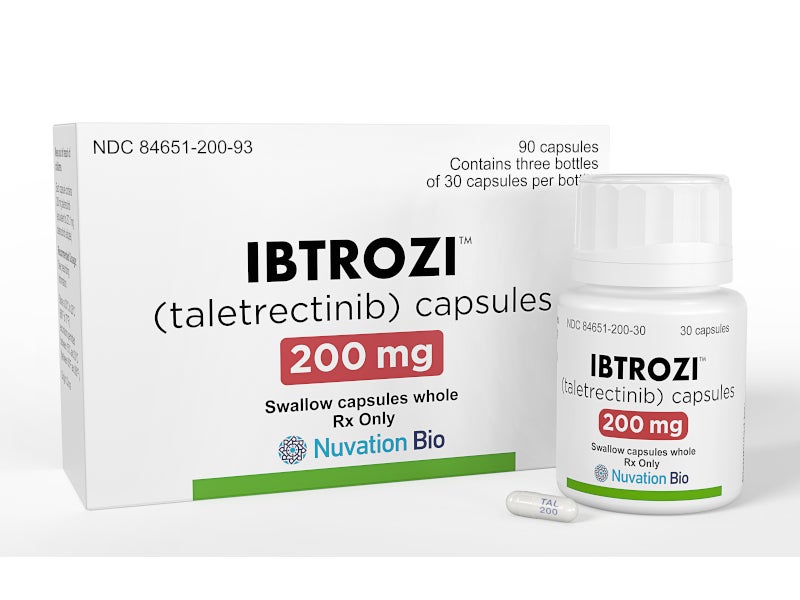

IBTROZI™ (taletrectinib) is a tyrosine kinase inhibitor indicated for the treatment of adults with locally advanced or metastatic non-small cell lung cancer (NSCLC) associated with an abnormal ROS1 gene.
Developed by Nuvation Bio, the targeted oral therapy is available in the form of 200mg capsules.
Recommended Buyers Guides

In June 2025, the National Comprehensive Cancer Network Clinical Practice Guidelines listed IBTROZI as a Preferred Agent for both initial and subsequent therapy in ROS1-positive NSCLC.
Regulatory approvals for IBTROZI
China’s National Medical Products Administration (NMPA) approved taletrectinib in January 2025.
It is marketed under the brand name DOVBLERON® under an exclusive licensing arrangement with Innovent Biologics.
The US Food and Drug Administration (FDA) granted approval for IBTROZI in June 2025, following a New Drug Application submitted in October 2024, which was granted Priority Review status in December 2024.
The FDA previously granted Orphan Drug Designation to taletrectinib for the treatment of ROS1-positive, NTRK-positive, ALK-positive, LTK-positive, ACK1-positive and DDR1-positive NSCLC.
Both the FDA and China’s NMPA awarded Breakthrough Therapy Designation to taletrectinib.
Japan’s Ministry of Health, Labour and Welfare approved IBTROZI in September 2025.
ROS1 positive NSCLC causes and symptoms
NSCLC is the most prevalent form of lung cancer, with over one million diagnoses annually worldwide. ROS1-positive NSCLC accounts for approximately 1-3% of NSCLC cases globally.
Up to 35% of people newly diagnosed with metastatic ROS1-positive NSCLC have tumours that have spread to their brain (brain metastases), increasing up to 55% for those whose cancer has progressed following initial treatment.
This form of lung cancer is typically diagnosed at a median age of about 50 years and is more frequently seen in individuals who have never smoked. Metastatic spread to the brain is common and represents a major driver of disease progression and death in this patient group.
IBTROZI’s mechanism of action
Taletrectinib functions by inhibiting tyrosine kinase ROS1, including resistance mutations, and exhibits inhibitory activity against the three subtypes of tropomyosin receptor kinases, including TRKA, TRKB and TRKC.
Fusion proteins containing ROS1 domains can lead to uncontrolled cell proliferation through hyperactivation of downstream signalling pathways. Taletrectinib suppresses the proliferation of cancer cells harbouring ROS1 fusion genes and associated mutations.
Clinical trials on IBTROZI
The FDA approval of IBTROZI was based on the TRUST clinical programme comprising two Phase II multicentre, single-arm, open-label clinical trials, TRUST-I and TRUST-II, involving 270 patients with ROS1-positive locally advanced or metastatic NSCLC who received taletrectinib.
Participants were administered taletrectinib at a daily oral dose of 600mg.
Key efficacy endpoints included confirmed overall response rate (ORR) and duration of response (DOR) as per RECIST v1.1, assessed by a blinded independent central review (BICR). Intracranial response was also evaluated using modified RECIST v1.1 by BICR.
The efficacy analysis comprised 157 patients who had not previously received a ROS1 TKI and 113 who had received one prior ROS1 TKI. Eligibility allowed for patients to be either chemotherapy-naive or previously treated with chemotherapy for locally advanced disease.
In the TRUST-I trial, among 103 patients with ROS1 TKI-naive NSCLC, 90% (93) achieved ORR. The maximum observed DOR was 46.9 months, with 72% maintaining response for over a year.
Of the 66 patients in the TRUST-I study with prior TKI therapy, 52% (34) achieved ORR. The longest DOR recorded was 38.7 months, with 44% sustaining response for more than a year.
In the TRUST-II study, 85% (46) of 54 ROS1 TKI-naive patients achieved ORR. The longest DOR was 30.4 months, with 63% responding for over a year.
Among 47 patients in TRUST-II with prior TKI therapy, 62% (29) achieved ORR. The maximum DOR observed was 30.4 months, with 45% maintaining response for over a year.
The most commonly reported adverse reactions in the trials were diarrhoea, nausea, vomiting, dizziness, rash, constipation and fatigue.
TRUST IV, an ongoing Phase 3 study, aims to enrol approximately 180 patients across the US, Canada, Europe, Japan and China with ROS1-positive stage IB, II or IIIA NSCLC who have undergone surgery. The primary endpoint of the trial is disease-free survival, with completion anticipated in 2033.
