
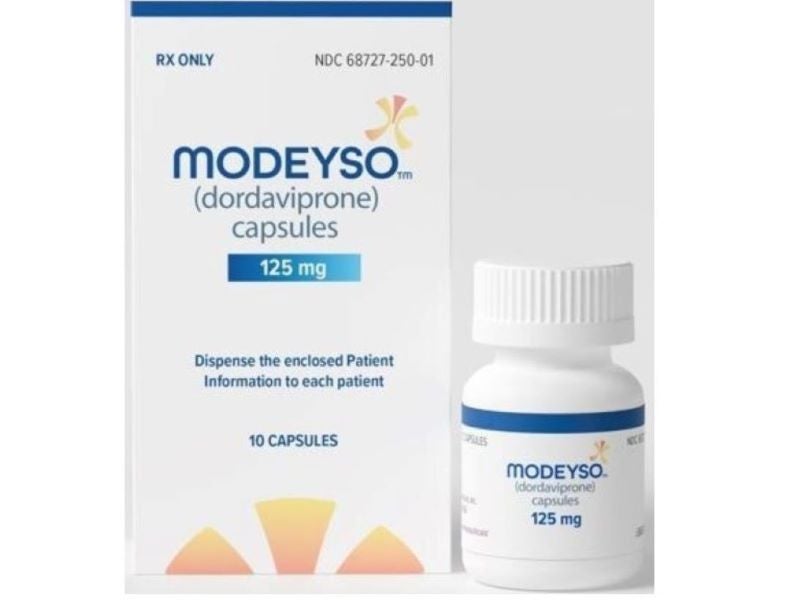


Modeyso™ (dordaviprone) is indicated for the treatment of adult and paediatric patients aged one year and older with diffuse midline glioma (DMG) characterised by an H3 K27M mutation, whose condition has advanced after prior treatment.
The therapy was initially developed by Chimerix and was later acquired by Jazz Pharmaceuticals in April 2025.
Recommended Buyers Guides

Modeyso is available as 125mg white, opaque and hard capsules administered orally.
Regulatory approvals for Modeyso
In August 2025, the US Food and Drug Administration (FDA) granted accelerated approval for Modeyso for use in adult and paediatric patients aged one year and above with DMG harbouring an H3 K27M mutation, whose disease has progressed following previous therapy.
Continued approval may depend on confirming and characterising clinical benefit in the Phase III ACTION study.
Subsequently, in September 2025, the National Comprehensive Cancer Network® (NCCN®) Clinical Practice Guidelines in Oncology (NCCN Guidelines®) recommended Modeyso (dordaviprone) as a category 2A single-agent treatment option.
H3 K27M-mutant DMG causes and symptoms
H3 K27M-mutant DMG is a rare and aggressive brain tumour that predominantly occurs in the midline regions of the brain and spinal cord. It is defined by the presence of the H3 K27M genetic mutation, which alters epigenetic control mechanisms and promotes tumour progression.
This glioma type is most frequently diagnosed in children and young adults, who typically experience a poor prognosis, limited treatment options and low survival rates upon recurrence. In the US, the tumour impacts approximately 2,000 individuals annually.
Median survival is around one year from diagnosis, with less than six months following disease progression after initial therapy.
Modeyso’s mechanism of action
Dordaviprone functions as a protease activator of mitochondrial caseinolytic protease P and also acts as an inhibitor of the dopamine D2 receptor.
DMG with an H3 K27M mutation are characterised by a loss of H3 K27 trimethylation.
In vitro studies have shown that dordaviprone activates the integrated stress response, promotes apoptosis and modifies mitochondrial metabolism, resulting in the restoration of histone H3 K27 trimethylation in H3 K27M-mutant diffuse glioma models.
Dordaviprone has demonstrated anti-tumour activity in both cell-based assays and in vivo models of H3 K27M-mutant diffuse glioma.
Clinical trials on Modeyso
The efficacy of Modeyso was assessed in adult and paediatric patients with glioma through five open-label, non-randomised clinical studies conducted in the US (ONC006, ONC013, ONC014, ONC016, and ONC018).
Pre-defined criteria were used to establish an integrated efficacy population. Eligible participants were required to have received Modeyso as a single agent and have DMG with an H3 K27M mutation and progressive, measurable disease as defined by Response Assessment in Neuro-Oncology-High Grade Glioma (RANO-HGG) criteria.
Additionally, participants needed to be at least 90 days post-radiation therapy, have completed adequate washout from prior anti-cancer treatments, possess a Karnofsky Performance Status/Lansky Performance Status score of 60 or higher, and demonstrate stable or decreasing use of corticosteroids.
A total of 50 patients met these criteria and were included in the integrated efficacy population. The primary efficacy endpoint was overall response rate (ORR), evaluated by blinded independent central review (BICR) according to RANO 2.0 criteria.
Additional efficacy endpoints included BICR-assessed ORR according to RANO-HGG and Response Assessment in Neuro-Oncology-Low Grade Gliomacriteria, as well as duration of response and time to response.
The ORR, as determined by BICR using RANO 2.0 criteria, was 22%, with one additional responder identified through integrated RANO 2.0 assessment.
Among those who responded, the median duration of response was 10.3 months; 73% maintained their response for at least six months and 27% for at least 12 months.
The most frequently reported adverse reactions to Modeyso were fatigue, headache, vomiting, nausea and musculoskeletal pain.
Ongoing clinical trials on Modeyso
ACTION is a randomised, double-blind, placebo-controlled, parallel-group, international Phase III trial investigating the safety and efficacy of Modeyso in newly diagnosed patients with H3 K27M‑mutant diffuse glioma after completing radiotherapy.
Following completion of standard frontline radiotherapy, participants are randomised in a 1:1:1 ratio to receive either placebo, once-weekly dordaviprone, or twice-weekly dordaviprone administered on two consecutive days.
The primary efficacy endpoints are overall survival and progression-free survival (PFS), with PFS evaluated by BICR using RANO-HGG criteria.
Secondary endpoints include assessment of safety, additional efficacy parameters, clinical benefit and quality of life.
