

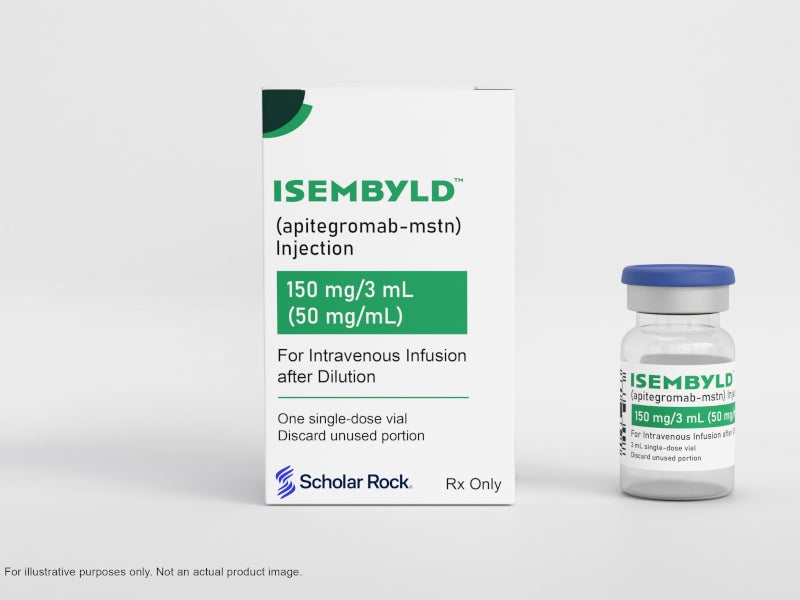

ISEMBYLD™ (apitegromab-mstn) is the first approved treatment for spinal muscular atrophy
(SMA) to directly address muscle loss. It is designed to work alongside existing treatments, targeting an important aspect of the disease.
Recommended Buyers Guides

Developed by Scholar Rock, ISEMBYLD injection was approved by the US Food and Drug Administration (FDA) in September 2026 for adults and paediatric patients aged two years and older with SMA who are receiving an SMN2-targeted treatment.
The FDA granted ISEMBYLD fast track, orphan drug and rare paediatric disease designations. The European Commission has also awarded orphan drug designation to the drug.
The treatment is supplied as an injection containing 150mg/3ml (50mg/ml) of apitegromab-mstn. It is a clear to moderately opalescent solution, ranging from colourless to slightly yellow, provided in a single-dose vial.
SMA causes and symptoms
SMA is a rare, progressive neuromuscular condition that affects around one in 10,000 live births. It is among the principal genetic causes of infant mortality.
The disease causes irreversible motor neuron loss, atrophy in the voluntary muscles of the limbs and trunk, and progressive muscle wasting. These effects cause motor function to decline continuously over a patient’s lifetime and can reduce independence in both children and adults.
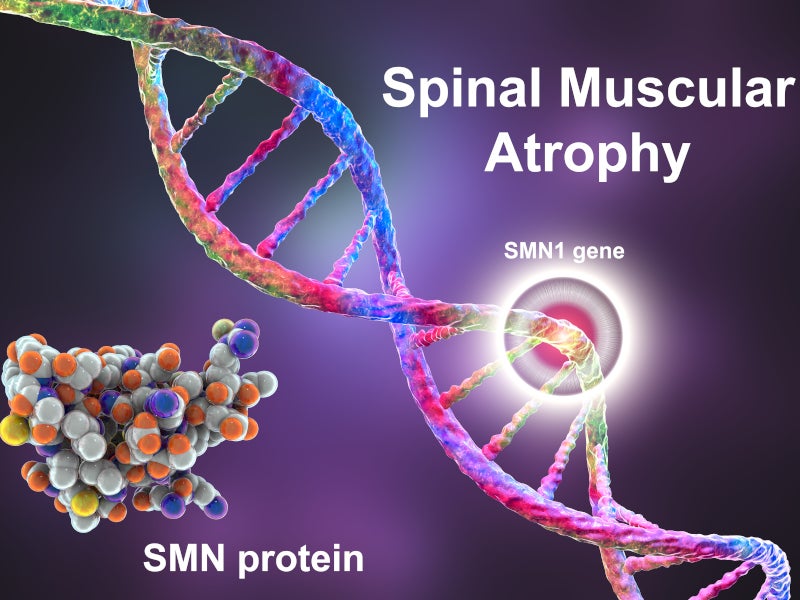
The condition results from a defective SMN1 gene, which does not generate the protein required for motor neuron survival, leading to worsening muscle weakness and muscle wasting.
SMN2 is a backup gene that generally produces a defective version of the required protein. Existing SMN2-targeted treatments correct this issue, allowing the body to make sufficient quantities of the missing protein to maintain motor neuron survival. An estimated 35,000 SMA patients worldwide have received an SMN-targeted gene therapy.
Although these therapies have materially improved outcomes for many patients, people with more advanced disease can still face significant motor limitations including impaired ability to walk or move independently. This creates a need for treatments that directly address muscle loss.
Mechanism of action
ISEMBYLD is a fully human monoclonal immunoglobulin G4 (IgG4) antibody that contains apitegromab as its active substance.
Apitegromab is a protein designed to bind to inactive, or latent, forms of myostatin, a protein that restricts muscle growth. By inhibiting these latent forms from becoming active, apitegromab decreases myostatin’s effects, helping to prevent muscle loss and preserve muscle mass.
Clinical trials on ISEMBYLD
The efficacy and safety of ISEMBYLD were evaluated in the 52-week, randomised, double-blind, placebo-controlled Phase III SAPPHIRE study (NCT05156320). The trial recruited 188 non-ambulatory SMA participants aged two to 21 years across nine countries, all of whom were receiving an authorised SMN2-directed therapy.
Patients were randomised to receive either intravenous ISEMBYLD at 10mg/kg, ISEMBYLD at 20mg/kg, or a placebo infusion once every four weeks for roughly one year. The primary analysis focused on a subgroup of 156 patients aged two to 12 years.
The study’s primary efficacy endpoint measured the average change from baseline after one year in the Hammersmith Functional Motor Scale-Expanded (HFMSE), an assessment of motor function in SMA patients, with higher scores indicating better motor function. HFMSE comprises 33 scored activities that provide objective evidence of motor ability and clinical progression, including the ability to sit unaided, stand and walk.
The SAPPHIRE clinical trial achieved its primary endpoint, demonstrating a clinically meaningful 2.2-point HFMSE improvement in patients receiving ISEMBYLD 10mg/kg alongside an SMN2-targeted treatment compared with patients receiving an SMN2-targeted treatment alone after one year. In addition, 34.2% of ISEMBYLD-treated patients achieved an HFMSE increase of at least three points, compared with 13.5% of placebo-treated patients.
ISEMBYLD has a well-characterised safety profile. Its safety database covers more than 500 individuals enrolled in apitegromab clinical studies worldwide, including some individuals who have received treatment for more than seven years.
In the SAPPHIRE trial, the most frequently reported adverse reactions were upper respiratory tract infections, vomiting, cough, other viral infections and headache, as well as gastroenteritis, pharyngitis and hypersensitivity. Of the participants treated in SAPPHIRE, 98% chose to continue into the ongoing, open-label ONYX multi-centre extension study assessing the long-term safety and efficacy of apitegromab in participants with Type 2 and Type 3 SMA who completed either the TOPAZ Phase II trial or the SAPPHIRE trial.
