

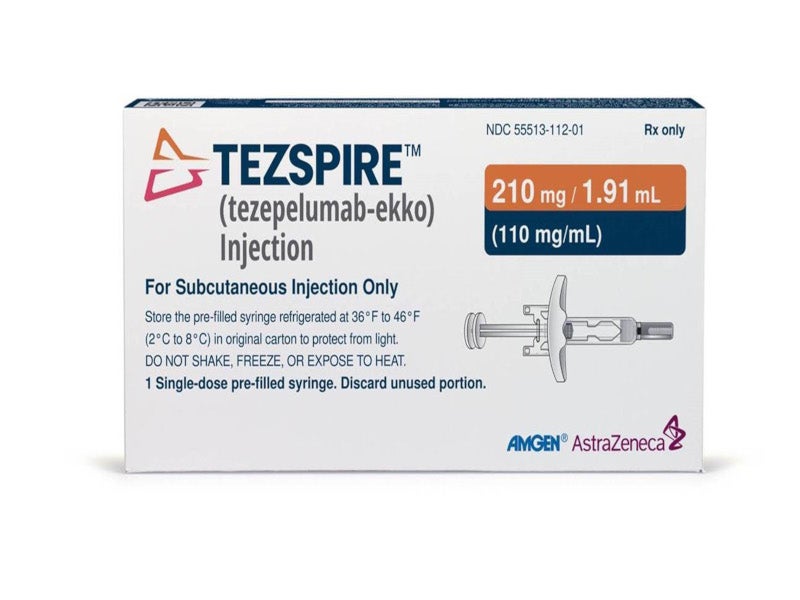


Tezspire (tezepelumab-ekko) is a first-in-class human monoclonal antibody indicated for add-on maintenance treatment of severe asthma in adults and children aged 12 years and above whose condition cannot be managed by their existing asthma medication.
Tezspire is the first and only biologic option for severe asthma, irrespective of any phenotypic or biomarker limitations within the approved label. It is also the first severe asthma therapy not restricted to a certain form of severe asthma.
Recommended Buyers Guides

The drug was developed under a collaboration agreement made by Amgen and AstraZeneca in April 2012 that included the development and commercialisation of Amgen’s clinical inflammation portfolio, including tezepelumab.
The agreement was updated in 2020. Under the revised agreement, Amgen acts as the principal in North America for Tezspire sales in the US, while AstraZeneca acts as the principal for Tezspire sales in Canada. Outside North America, AstraZeneca has primary responsibility for the commercialisation of Tezspire. Both companies continue to split costs and profits equally following AstraZeneca’s payment of a mid-single-digit inventor royalty to Amgen.
Tezspire is available as a clear-to-opalescent, colourless-to-light yellow solution in a single-dose vial or a pre-filled syringe containing 210mg/1.91ml tezepelumab-ekko for subcutaneous administration.
Regulatory approvals for Tezspire
Tezspire holds a breakthrough therapy designation for patients with severe asthma without an eosinophilic phenotype and an orphan drug designation for the treatment of eosinophilic esophagitis from the US Food and Drug Administration (FDA).
The FDA received a biologics licence application for Tezspire in May 2021 and approved the drug in December 2021 after a priority review in July 2021.
Swissmedic, the Swiss Agency for Therapeutic Products, approved the drug in June 2022.
Tezspire was approved by the EU as an add-on maintenance treatment in patients with severe asthma aged 12 years and older, who are inadequately controlled with high-dose inhaled corticosteroids plus another medicinal product, in September 2022.
In the same month, the Japanese Ministry of Health, Labour and Welfare approved Tezspire for treating severe or refractory bronchial asthma in patients who cannot control symptoms with corticosteroids and other long-term maintenance therapies.
Tezspire was made available in Canada as an adjunct medication for adults and adolescents with severe asthma in October 2022.
In January 2023, Tezspire was approved for self-administration with a pre-filled, single-use pen in the EU, followed by the FDA in February 2023.
In October 2025, the FDA approved tezepelumab-ekko as an add-on maintenance treatment of inadequately chronic rhinosinusitis with nasal polyps (CRSwNP) in adult and paediatric patients aged 12 years. The drug was also approved in the EU for the same indication in the same month.
Tezspire is also being studied for additional possible indications including chronic obstructive pulmonary disease and chronic spontaneous urticaria.
Asthma causes and symptoms
Asthma is a chronic inflammatory condition that causes inflammation in the airways of the lungs. It can be caused by multiple factors, including allergen or irritant exposure and viral infections.
An asthma episode or exacerbation can include wheezing, coughing, chest tightness and difficulty in breathing. Short-term treatments typically do not alleviate severe asthma symptoms.
Severe asthma affects between 5% and 10% of all asthmatic patients in the US. The case can be strong, continue for a long time and can interfere with regular activities.
Tezspire’s mechanism of action
Tezspire is the first asthma medication that targets thymic stromal lymphopoietin (TSLP), an epithelial cytokine that plays a crucial role in the asthma inflammatory mechanism.
Inflammation of the airways is a key factor in the pathophysiology of asthma. It is caused by a variety of cell types including eosinophils, lymphocytes, macrophages, mast cells, AIneutrophils and type II innate lymphoid cells (ILC2), as well as mediators such as histamine, eicosanoids, leukotrienes and cytokines.
The proper mechanism of action of Tezspire in asthma is still unknown. The drug binds to human TSLP and blocks its interaction with the TSLP receptor. The interaction reduces the biomarkers and cytokines associated with inflammation, including blood eosinophils, airway submucosal eosinophils, IgE, IL-5 and IL-13.
Clinical trials on Tezspire
The FDA’s approval of Tezspire was based on the positive results from the PATHFINDER clinical trial programme, which included results from two clinical trials, namely PATHWAY and NAVIGATOR.
Both clinical studies are 52-week, randomised, double-blind, parallel-group, placebo-controlled trials, which enrolled a total of 1,609 severe asthma patients aged 12 years and older.
The 52-week dose-ranging, Phase IIb exacerbation trial PATHWAY enrolled 550 adult patients with severe asthma who were administered Tezspire 70mg subcutaneously once every four weeks. They were also subcutaneously administered Tezspire 210mg once every four weeks, Tezspire 280mg once every two weeks, or a placebo.
The 52-week Phase III exacerbation trial NAVIGATOR included 1,061 adult and paediatric patients with severe asthma who received Tezspire 210mg or placebo subcutaneously once every four weeks.
The primary outcome measure of the PATHWAY and NAVIGATOR trials was the rate of clinically severe asthma exacerbations after 52 weeks.
Tezspire significantly reduced the annualised rate of asthma exacerbations in patients compared to placebo in both trials.
Exacerbations necessitating emergency department visits or hospitalisation in individuals treated with Tezspire were also fewer than those in the placebo group.
The most common side effects reported in patients treated with Tezspire during the clinical trials were nasopharyngitis, upper respiratory tract infection and headache.
Clinical trials on Tezspire pre-filled pen
The Phase III PATH-HOME multi-centre, open-label, parallel-group trial evaluated Tezspire single-use, pre-filled syringe (PFS) or auto-injector (AI) in 216 patients aged 12 years and older with severe asthma.
The patients were administered a fixed 210mg dose every four weeks in a clinic and an at-home setting.
At weeks 12 and 16, 97% of patients successfully carried out administration with Tezspire pre-filled pen at home setting.
The low equipment failure rate (0.8% for AIs and 0.9% for PFS) indicated adequate instructions for safe subcutaneous administration of Tezspire both at home and in the clinic.
The PATH-BRIDGE trial is a single-centre, randomised, open-label, parallel-group Phase I trial in healthy participants to compare pharmacokinetic (PK) exposure of a single 210mg dose of Tezspire administered via vial-and-syringe, pre-filled AI device or plasma fractionation system.
The results of the study showed that all device groups experienced mild-to-moderate injection site pain, while injection site responses were rare. The PK exposure was equivalent for all device groups.
The most common adverse events reported in patients treated with Tezspire during the clinical trials were pharyngitis, arthralgia and back pain.
Additional trials on tezepelumab
The safety and efficacy of tezepelumab in adults with CRSwNP were investigated in the Phase III WAYPOINT trial, a double-blind, multicentre, randomised, placebo-controlled, parallel‑group study.
A total of 203 participants were allocated to receive tezepelumab and 205 to receive a placebo, both administered by subcutaneous injection. Treatment with tezepelumab led to statistically significant reductions in nasal polyp severity based on the co‑primary endpoints.
At week 52, patients in the tezepelumab arm showed greater improvements than those in the placebo arm in total nasal polyp score by -2.458 compared to -0.392 in the placebo group, and in mean nasal congestion score by -1.743 compared to -0.715 in the placebo group.
The most frequently reported adverse events associated with tezepelumab in the WAYPOINT trial were Covid‑19, nasopharyngitis and upper respiratory tract infection.
