

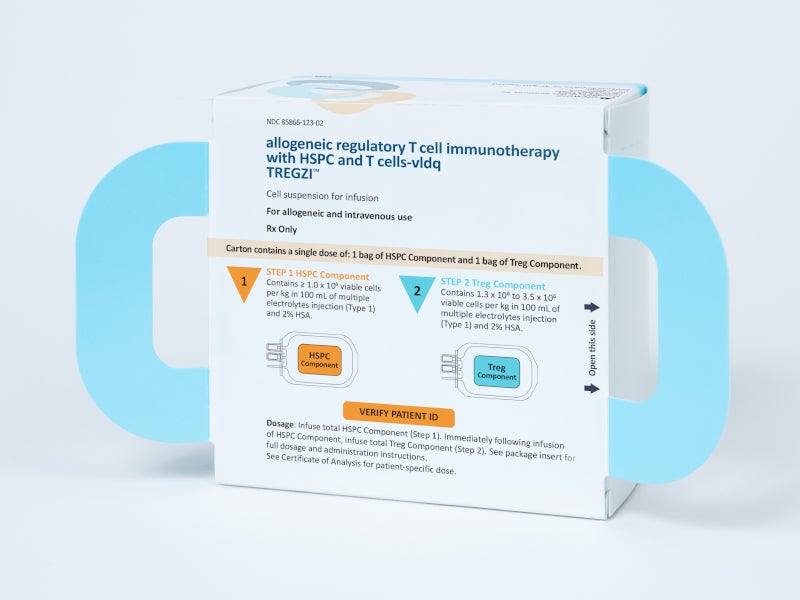
TREGZI™ is an allogeneic regulatory T-cell immunotherapy comprising haematopoietic stem and progenitor cells (HSPCs) and T cells-vldq. The precision-engineered cell therapy is intended to treat adults with haematological malignancies.
Developed by commercial-stage biotechnology company Orca Bio, TREGZI is used in matched-donor haematopoietic stem cell transplantation (HSCT) following a myeloablative conditioning regimen. It is designed to support haematopoietic and immune-system reconstitution and improve chronic graft-versus-host disease (GVHD)-free survival (cGFS).
Recommended Buyers Guides

The US Food and Drug Administration approved TREGZI in June 2026. The approval represents a potential new personalised cell therapy option for adults with haematological malignancies undergoing stem cell transplantation, with the aim of improving survival without chronic GVHD.
Known clinically as Orca-T®, TREGZI is supplied as a single, patient-specific dose consisting of four separate infusion bags containing HSPCs, regulatory T cells (Tregs), conventional T cells (Tcons), and Tcon diluent. Each individually labelled infusion bag contains a batch-dependent concentration of allogeneic cells.
Causes and symptoms of haematological malignancies
Haematological malignancies, commonly referred to as blood cancers, develop when genetic mutations, epigenetic modifications, or environmental factors impair the standard differentiation and self-renewal mechanisms of haematopoietic stem cells (HSCs) within the bone marrow.
These conditions are grouped into three primary classifications: leukaemia, lymphoma, and multiple myeloma (MM).
Leukaemia affects blood-cell production and disrupts normal homeostasis. Its main subtypes include acute myeloid leukaemia (AML), chronic myeloid leukaemia (CML), acute lymphocytic leukaemia (ALL), and chronic lymphocytic leukaemia (CLL).
Lymphoma develops when lymphocytes undergo abnormal transformation and proliferate in the lymph nodes and other tissues. It includes Hodgkin lymphoma, non-Hodgkin lymphoma (NHL), AIDS-related lymphoma, and primary central nervous system lymphoma. Common NHL subtypes include diffuse large B-cell lymphoma (DLBCL), follicular lymphoma (FL), mantle cell lymphoma, and Burkitt lymphoma.
MM is characterised by the abnormal differentiation and proliferation of plasma cells in the bone marrow. Although its precise cause remains unclear, genetic abnormalities involving oncogenes such as MYC, NRAS, and KRAS may influence plasma-cell growth.
Despite progress in therapeutic interventions, blood cancers continue to be linked with poor patient outcomes, elevated rates of relapse, and substantial treatment-associated toxicities, especially across adult and high-risk cohorts.
TREGZI’s mechanism of action
TREGZI represents a personalised intervention produced on a patient-by-patient basis using living cells sourced from a matched donor. The therapeutic regimen employs HSPCs to re-establish the immune system, highly purified Tregs to inhibit GVHD, and Tcons to expedite immunological reconstitution while generating graft-versus-leukaemia (GVL) activity.
Tregs are administered before Tcons to manage GVHD and support immune reconstitution. After two days, Tcons are infused to accelerate immune reconstitution, evidenced by the whole or partial recovery of T-cell counts in the peripheral blood. This immunological recovery is believed to drive both graft-versus-infection and GVL responses.
The precise mechanism through which Tregs produce their effects is not completely understood. Non-clinical evaluations show that the immunosuppressive function of Tregs is mediated through multiple immunoregulatory pathways, which help preserve immune function and reduce GVHD severity.
Clinical trials on TREGZI
The FDA approval of TREGZI was supported by results from the randomised, open-label, multi-centre Precision-T Phase III trial (NCT05316701).
The study assessed the safety, efficacy, and tolerability of TREGZI in patients with AML, ALL, high-risk myelodysplastic syndrome (MDS) and mixed-phenotype acute leukaemia (MPAL).
Precision-T compared TREGZI plus single-agent tacrolimus (TAC) with conventional alloHSCT supported by TAC and methotrexate (TAC/MTX). Orca Bio developed the clinical trial design based on FDA guidance.
The trial enrolled 187 patients across 19 treatment centres in the US, with a median age of 43.6 years and an age range of 19-65 years.
The primary endpoint was cGFS, measured from HSCT until death from any cause or the first occurrence of moderate or severe cGFS within two years of day zero. Secondary efficacy endpoints included time to moderate or severe cGVHD, OS, and GVHD-free/relapse-free survival (GRFS).
At one year, cGFS was reported in 78% of patients treated with TREGZI, compared with 38% in the conventional alloHSCT group. The rate of cGVHD was 13% with TREGZI and 44% with alloHSCT, while OS was 94% and 83%, respectively.
GRFS was reached in 63% of patients in the TREGZI arm, compared with 31% in the alloHSCT arm.
Furthermore, non-relapse mortality (NRM) was 3% among TREGZI recipients and 13% among alloHSCT recipients.
Among patients in the TREGZI safety population, the most frequently reported adverse reactions were mucositis, bacterial infection, and viral infection.
