

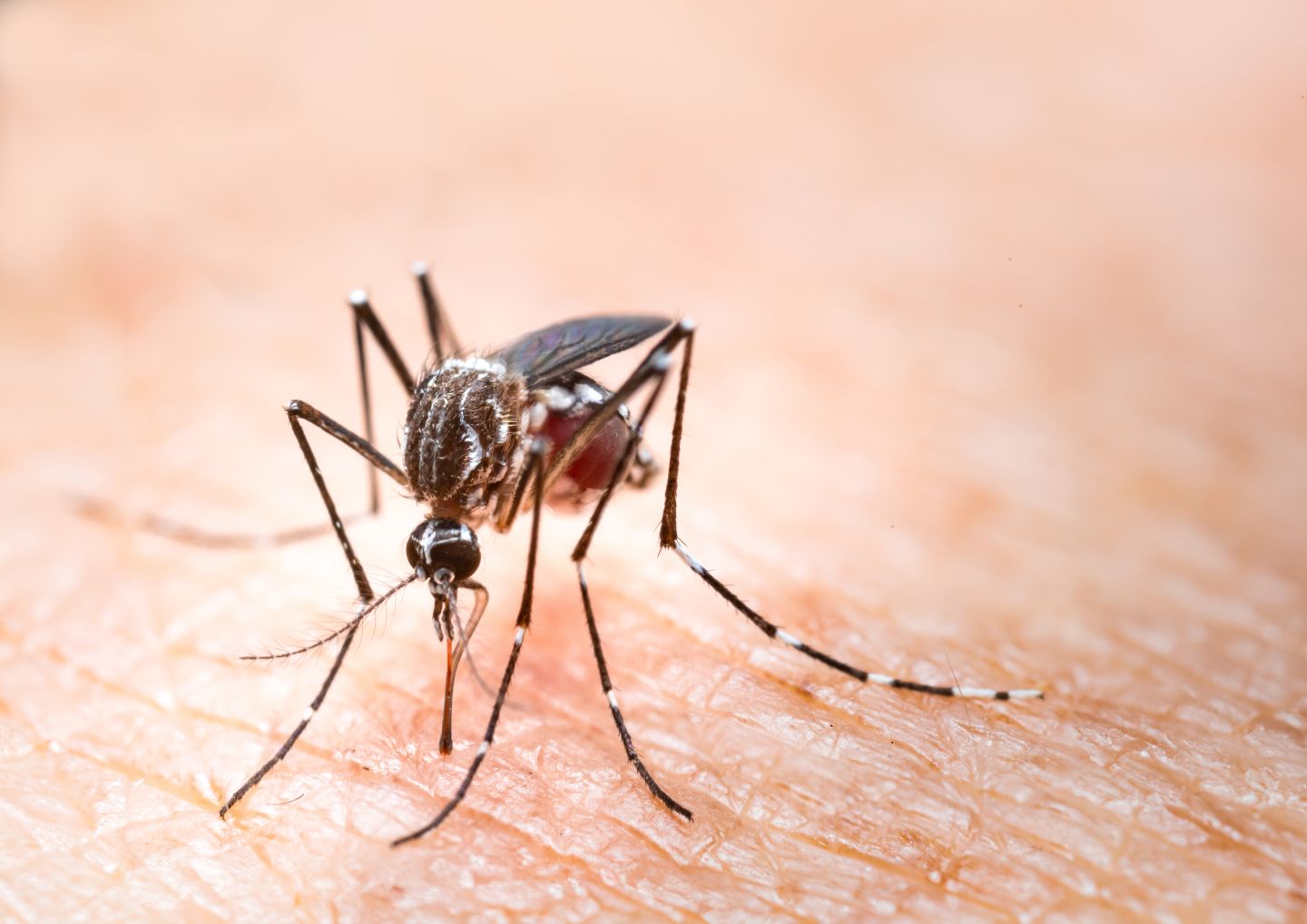
Malaria is a bloodborne parasitic disease wherein Plasmodium parasites are transmitted by mosquito vectors. Despite efforts to control mosquito populations, malaria is still endemic in parts of South America, Asia, and Africa. A March publication in Science by Jacob Tennessen and colleagues investigated the population genomics of Anopheles (Nyssorhynchus) darlingi, a major transmission vector of malaria in South America. The study researchers found that An. darlingi are evolving to develop insecticide resistance.
Tennessen and colleagues sequenced the genomes of 1,094 mosquitoes from six countries (Brazil, Colombia, French Guiana, Guyana, Peru and Venezuela). They noted that some genetic variations were repeatedly seen among neighbouring populations, specifically within a 150kb window that covers six genes encoding cytochrome P450. Mutations in P450 genes have been connected to resistance to pyrethroid insecticides, as seen in An. funestus and An. gambiae mosquitoes in sub-Saharan Africa.
Go deeper with GlobalData


Access deeper industry intelligence
Experience unmatched clarity with a single platform that combines unique data, AI, and human expertise.
The authors further defined the highly selected mutation as a polymorphism in the CYP6AA1 gene, where one allele codes for threonine and the other codes for lysine at site 283. To test whether the polymorphism confers insecticide resistance, 16 wild An. darlingi were captured and treated with deltamethrin. Mosquitos with the threonine-lysine polymorphism survived significantly longer than either threonine or lysine homozygotes. An. darlingi populations are therefore selecting for mutations that allow for increased resistance to deltamethrin.
According to the 2025 World Malaria Report published by the World Health Organization (WHO), the number of malaria cases increased 15.7% in the Americas during 2015–2024, and 75% of these cases came from Venezuela, Brazil, and Colombia. GlobalData epidemiologists forecast that there will be more than 160,000 confirmed incident cases and more than 1.6 million estimated incident cases of malaria in Brazil in 2026.
A major facet of malaria elimination is vector control. Pyrethroid resistance is already present in African Anopheles mosquitoes, and it appears to be independently developing in An. darlingi as well. As evolutionary pressure continues to select for insecticide resistance, it will be harder to control mosquito populations, and the elimination of malaria will become increasingly difficult. Other mechanisms of vector and disease control will need to be prioritised.

