
The Asia-Pacific (APAC) clinical trial landscape is undergoing a shift, with clinical trial activity rising two to three times faster than in Europe, a trend which is expected to accelerate over the next decade.
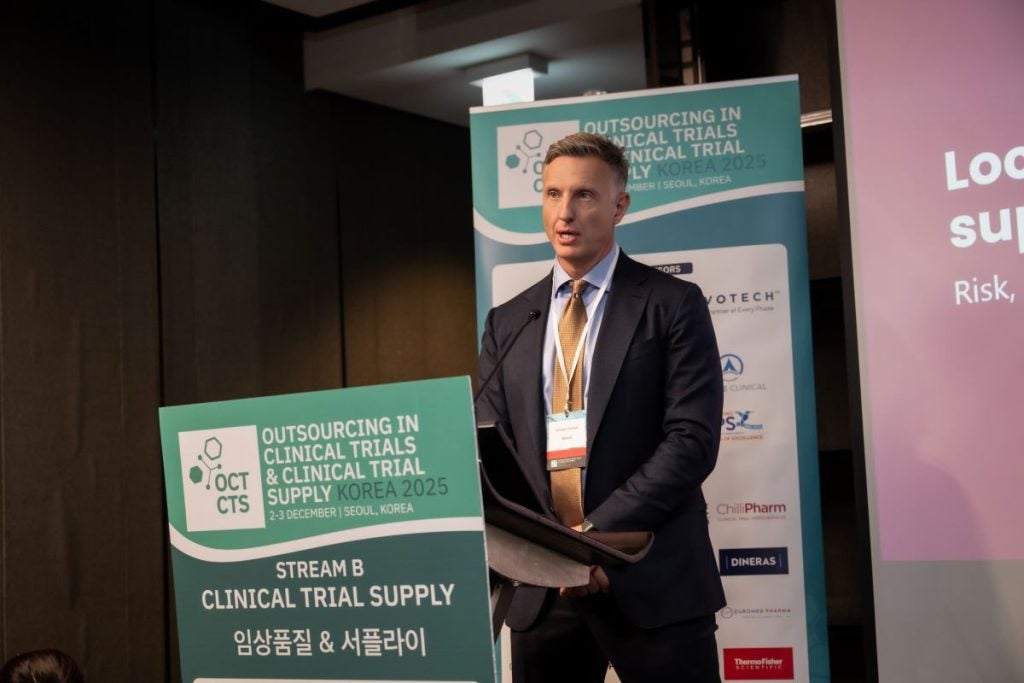
While the expansion is opening new opportunities for sponsors, it is also exposing critical vulnerabilities in the commercial supply chain, warned George Vlachos, co-CEO and co-founder of clinical trial supply company Akesa, at the Outsourcing in Clinical Trials (OCT) and Clinical Trial Supply (CTS) Korea 2025.
At the 10th Annual Outsourcing in Clinical Trials (OCT) and Clinical Trial Supply (CTS) Korea, which took place on 2–3 December in Seoul, South Korea, Vlachos emphasised that the APAC region sits at the forefront of global clinical development momentum.
He said: “50,000 trials are expected to be managed within the region in the coming years, requiring more than 20,000 individual registered product types,
“The growth is undeniable, but the supply chains have not caught up.”
A key driver behind this regional growth is the surge in research activities in China, with companies increasingly initiating early-phase studies in the region before expanding globally. Vlachos noted that Australia’s rapid startup environment, offering six-week trial approvals and generous R&D tax incentives, makes it a preferred site for Phase I activity.
Additionally, Japan’s renewed biotech investment, supported by the country’s Pharmaceuticals and Medical Devices Agency (PMDA), has also contributed to driving growth, he added. At the same time, Won1tn ($680m) was deployed in South Korea in the last 12 months by multinational drugmakers, according to the Korea Research-Based Pharma Industry Association.
Vlachos noted that established hubs such as Australia, Japan, South Korea and China will remain high-growth markets for the next 10–15 years, and India is expected to follow closely. Additionally, emerging markets are not far behind. He added that once the infrastructure in countries such as Indonesia, Vietnam, and the Philippines is in place, sponsors will have access to large treatment-naïve patient pools, and they need to be ready to leverage that.
Historically, sponsors relied on regional sourcing schemes. However, as the APAC region’s demand for commercial-grade pharmaceuticals for trials surges, European manufacturers are struggling to keep up, Vlachos mentioned. In addition, he commented that EU manufacturers are now restricting product access and approving supply only within the EU as they cannot meet the rising global demand, especially as LATAM clinical activity is also increasing.
Operational challenges and practical solutions
In the APAC region, fragmented regulatory pathways, with each country requiring distinct documentation, budgetary changes, and delays to start-up times and recruitment, are some of the operational pressures caused by the increased trial activity in the region.
In order to address those challenges, Vlachos urged sponsors to rethink traditional supply models and adopt regionalised sourcing strategies designed specifically for the APAC region’s complexity.
Adopting a multi-sourcing strategy by utilising both local and regional supply chain access points within the APAC region, as opposed to over-stretched EU sources, is key, according to the speaker. Additionally, supply chain requirements should be identified regionally, and APAC regulators should be engaged early for alignment on labelling, packaging, documentation, and acceptance pathways in each country, he added. Further, regional distribution hubs should be built to reduce transit timelines and help sponsors respond quickly to regulatory or market shifts, Vlachos said.
Later-phase programs, especially in oncology, metabolic disease, and cardiovascular trials, are now routinely anchored in APAC due to faster enrolment, large treatment-naïve populations, and maturing site networks. Still, this growing momentum brings unavoidable operational challenges as Phase III studies require significantly higher volumes of investigational medical product (IMP), comparators, and cold-chain infrastructure.
“Unless supply chains evolve at the same pace, sponsors will face increasing delays, higher costs, and greater risk,” Vlachos highlighted while urging speakers that now is the time to adapt.