

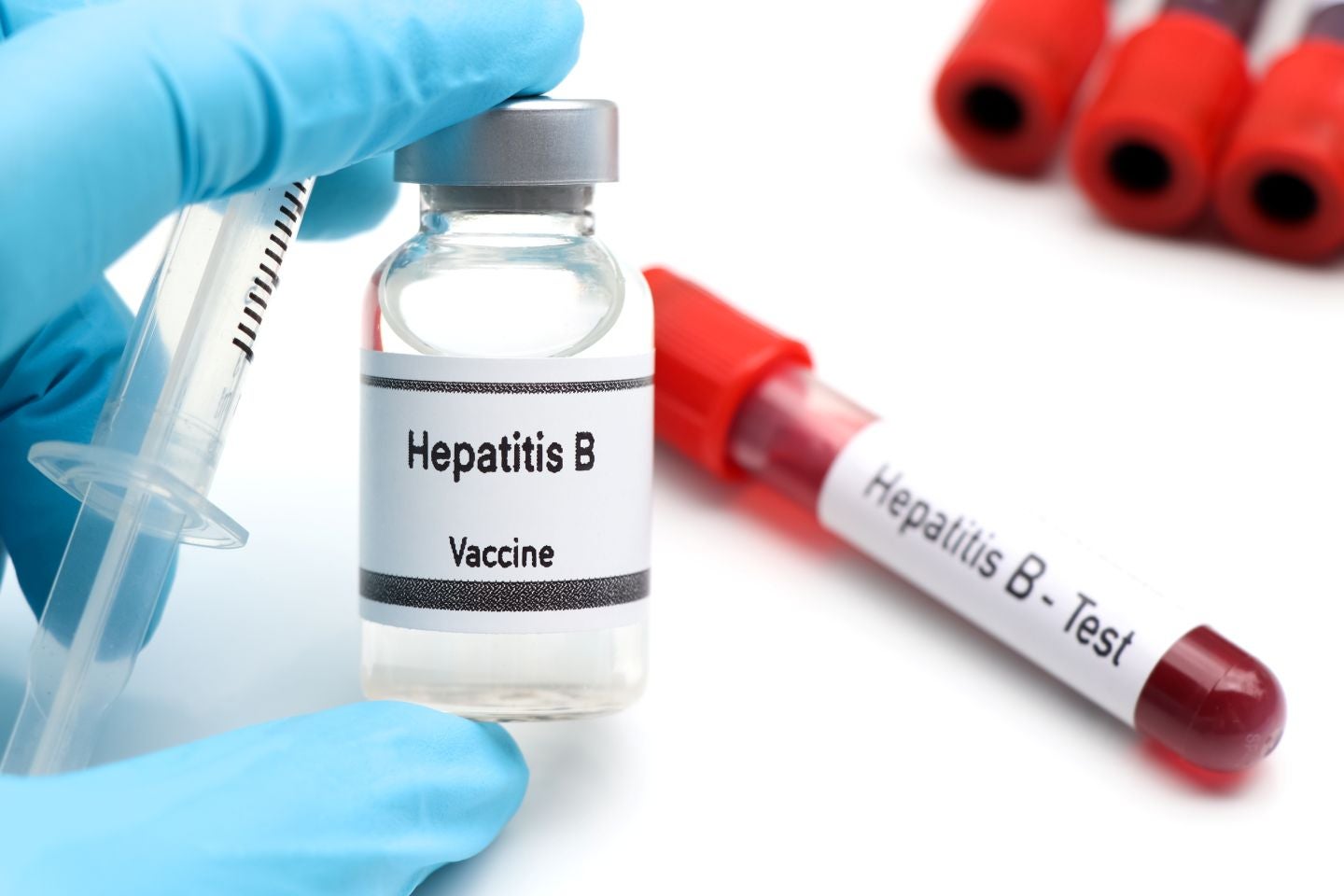
At the European Society of Clinical Microbiology and Infectious Diseases (ESCMID) Global 2026 conference in Munich, Germany, late-breaking data on a hepatitis B therapeutic vaccine candidate, TherVacB, was presented.
The development of TherVacB is a widespread effort, involving 17 partners, including Helmholtz Munich, the Technical University of Munich (TUM), the University Medical Center Hamburg-Eppendorf (UKE), the National Institute for Medical Research Mbeya Medical Research Center, and the Royal Free London NHS Foundation Trust. TherVacB is the recipient of a seven-year research grant through the EU’s Horizon 2020 research and innovation funding programme.
Go deeper with GlobalData


Access deeper industry intelligence
Experience unmatched clarity with a single platform that combines unique data, AI, and human expertise.
The hepatitis B virus (HBV) is transmitted through infected blood and body fluids and begins as a short-term illness that is self-limiting in the majority of individuals. However, if the body fails to clear the virus after six months, chronic hepatitis B (CHB) virus infection occurs. Current data estimates that 3.2% of the world’s population is living with CHB. CHB is a lifelong disease for most patients, and current treatment relies on the long-term daily usage of antiviral medications. Consequently, CHB patients are at a high risk of developing life-threatening complications, including liver cirrhosis and hepatocellular carcinoma (HCC).
Currently, there are no curative therapies available for CHB patients, although the late-stage development pipeline is poised to address this unmet need. The development of a functional cure for CHB represents one of the most prominent R&D trends in the HBV market, aiming to provide patients with shorter, finite treatment durations. Companies such as GSK, Gilead Sciences, Aligos Therapeutics, and Arbutus Biopharma have CHB functional cure drugs in late-stage development (Phase IIb and above). According to GlobalData, the early-mid-development pipeline (Phases I–II) contains over a dozen therapeutic HBV vaccines in development.
TherVacB, currently in Phase I development, is a therapeutic vaccine candidate designed as an immune therapy for CHB patients, which, upon receipt of the vaccine, will allow patients to clear the virus on their own, thereby leading to a functional cure. The strategy of TherVacB begins with patients taking antiviral pretreatment to reduce viremia, followed by protein prime vaccinations to induce neutralising antibodies and T-cell responses, and finally a boost vaccination to expand T-cell responses and control the CHB infection.
The data presented by UKE at ESCMID Global 2026 was a first-in-human, Phase Ia clinical trial, which assessed the safety and immunogenicity of TherVacB in healthy adults 18–65 years of age. Study participants were given variations of two heterologous protein prime vaccinations at Day 0 and Day 28, and then varying dosages of a modified vaccinia Ankara (MVA) boost vaccination at Day 56.
Solicited local adverse events were mild to moderate for all study participants, with pain at the injection site being the most commonly observed. Solicited systemic adverse events were mostly mild to moderate; however, grade 3 events were observed in an estimated three study participants. The most commonly observed systemic adverse events were headache and fatigue. A total of 77 unsolicited adverse events were reported, which were mostly mild to moderate. There were no adverse events of special interest, no vaccine-related serious adverse events, and only one unexpected event of self-limiting muscle fasciculations.
Overall, TherVacB was found to be safe, well-tolerated, and highly immunogenic among the healthy study participants. The last subject’s last visit for the Phase Ia trial is scheduled for May 2026, and the Phase Ib trial is currently enrolling CHB patients. The Phase I clinical data for TherVacB is promising and supports its continued development, but if successful, TherVacB is projected to enter into a highly competitive market due to the range of functional cure therapies currently in development for CHB.

